01-Jun-2026
Author: Om Educare
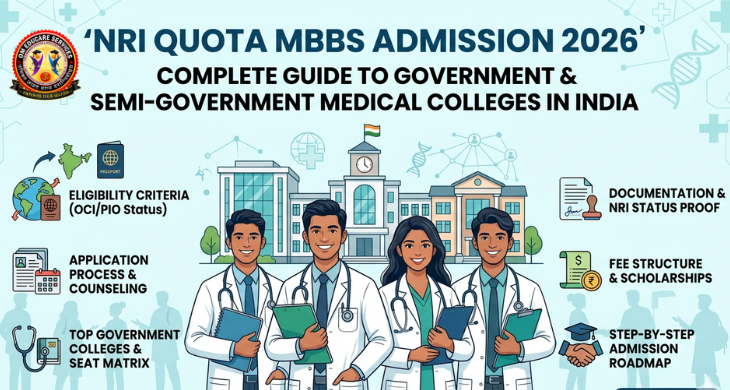
Every year, thousands of families with NRI connections ask the same question: "Our NEET score is not high enough for a general category government seat — is there another way?"
The answer is yes. And it is completely legal, completely official, and far less known than it should be.
It is called the NRI Quota — and for the right candidate, it can open the door to a government or semi-government MBBS seat even with a qualifying-level NEET score.
At Om Educare, we have helped numerous families navigate this route successfully. This blog is our most comprehensive guide to the NRI quota — what it is, who qualifies, which states offer it, what it costs, and what documents you need. Read every section carefully, because the details matter enormously here.
In many states across India, government and private medical colleges reserve up to 15% of their seats for NRI or NRI-sponsored candidates. These seats are filled through an official counselling process — separate from the general merit list — and they come with a different fee structure, typically paid in US dollars.
The single biggest advantage of the NRI quota is this: in most states, there is no high cutoff required. A student who has simply qualified NEET — scoring somewhere around 150 to 200 marks — can be eligible for a seat in a reputable government or semi-government medical college through this route.
For families where a general category government seat is out of reach and a fully private MBBS feels financially overwhelming, the NRI quota in government colleges often represents the most balanced middle ground.
Before going further, it is important to understand the legal definition.
An NRI (Non-Resident Indian) is an Indian citizen or a person of Indian origin who has stayed abroad for at least 182 days or more in the previous financial year — for the purpose of employment, business, or any other vocation.
This 182-day threshold is not negotiable. It is verified through passport stamps, visa records, and official employment or business documentation. Any misrepresentation here is treated as fraud.
Not every student applying under the NRI quota needs to be an NRI themselves. The quota is divided into three distinct sub-categories:
Category 1 — NRI Candidates: Students who are of Indian origin but have received their education outside India. They are themselves the NRI.
Category 2 — Children of NRI: Students whose parent — father or mother — qualifies as an NRI as per the 182-day definition. The student may have studied in India, but their parent's NRI status makes them eligible.
Category 3 — NRI Sponsored Candidates: Students who are sponsored by a close relative who is an NRI. This is the broadest and most commonly used sub-category, and it opens up the NRI quota to a much larger number of families.
This is where many families make mistakes — or where fraudsters try to mislead. The sponsor must be a first-degree blood relative. The following relationships are accepted:
No one beyond this list can be a sponsor. A distant relative, family friend, or second cousin does not qualify — regardless of what anyone tells you. Applications that misrepresent the relationship are rejected, and in serious cases they attract legal consequences.
This depends entirely on which college and which state you are looking at. But here is the honest framework:
Government and Semi-Government Colleges (NRI Quota): Total course cost typically starts from around Rs 40 to 50 lakh for the full MBBS programme. Some states charge in US dollars, ranging from approximately 50,000 to 1,21,500 for the entire course depending on the institution.
Private and Deemed Universities (NRI Quota): The budget here starts from approximately Rs 90 lakh and goes significantly higher. The private NRI quota is notably more expensive than the government route.
This is precisely why NRI quota seats in government and semi-government colleges are so valuable — they offer a far more affordable path compared to fully private NRI quota admissions, while still being attached to established government medical institutions.
AIIMS Delhi and AFMC Pune: AIIMS Delhi has 7 seats and AFMC Pune has 5 seats under a foreign national category. However, these are specifically for foreign nationals nominated by the central government — they are not open to regular NRI or OCI candidates.
JIPMER: JIPMER previously had 6 NRI quota seats, but this quota was discontinued from 2022 onwards. JIPMER seats are no longer available under NRI quota.
AMU — Aligarh Muslim University: AMU has 5 NRI quota seats. The 2023 cutoff was a NEET score of 574 (AIR 46,114). Total fee is 1,00,000 payable in one instalment. Sponsored candidates are eligible here, which makes it an attractive option for families with NRI relatives.
This is the most detailed and practically useful section of this guide. Eleven states currently offer NRI quota seats in government or semi-government colleges. Here is what you need to know about each:
Goa
Government college with 2 NRI seats. Total course fee is 50,000 for the full programme, payable in 4 instalments — making it one of the most payment-friendly options. One important condition: the student's Class 12 must have been completed outside India.
Chandigarh — GMCH
Government Medical College and Hospital Chandigarh offers 9 NRI seats. Total fee is 1,10,000, with 60,000 due at the time of admission and the remaining split over two years at 25,000 each. Sponsored candidates are not eligible here — only direct NRI or children of NRI can apply.
Punjab
Four government colleges in Punjab together offer 64 NRI seats — one of the largest pools of government NRI seats in the country. Total fee is 1,10,000 with 60,000 due at admission. A bank guarantee is required for the remaining fee installments. Sponsored candidates are not accepted under this state's NRI quota.
Gujarat
Gujarat does not offer NRI seats in its state government colleges. However, its semi-government GMERS colleges — 16 institutions — offer 421 NRI seats with a total budget of approximately 90,000. Municipal corporation medical colleges in Gujarat have a higher fee of 1,21,500. Sponsored candidates are not eligible in Gujarat.
Rajasthan
Rajasthan has one of the largest NRI seat pools in the country — 381 seats across 21 government medical colleges. The fee structure here is among the highest, with a total budget of approximately Rs 1.30 crore (calculated at 56,280 per year). However, Rajasthan is also one of the few states where sponsored candidates are fully eligible and where students with only qualifying NEET marks can secure admission. For families looking for maximum seat availability with sponsor eligibility, Rajasthan is a top priority.
Haryana
Government colleges in Haryana have 18 NRI seats with a fee of 25,000 per year (approximately 77,880 total). Semi-government Maharaja Agrasen Medical College has 3 additional NRI seats with a total fee of 75,000. Securing government seats in Haryana is difficult for sponsored candidates — direct NRI or children of NRI have better prospects here.
Himachal Pradesh
Six government colleges offer 20 NRI seats with a total fee of 1,00,000, structured at 20,000 per year over 5 years. Sponsored candidates are eligible, making this an accessible option for families with NRI relatives in the sponsorship category.
Andhra Pradesh
Five government colleges in Andhra Pradesh offer 118 NRI seats — a substantial pool. Fee is Rs 20 lakh per year, with a total course budget of approximately Rs 90 lakh. Sponsored candidates are eligible. For families looking for a southern state with a government college, Andhra Pradesh is among the best options available.
Puducherry
One government college with 22 NRI seats. Total fee is 1,00,000, payable in a single instalment at the time of admission. The lump-sum payment requirement can be a planning factor for families.
Assam
Twelve government colleges across Assam offer 88 NRI seats. Total fee is 1,00,000 with 25,000 due in the first year. The large number of colleges and the reasonable first-year payment make Assam a viable option for families exploring northeastern India.
Arunachal Pradesh
One college — Tomo Riba Institute — with 2 NRI seats. Total fee is 1,00,000 payable in a single instalment. Limited seats mean early application is critical.
Incomplete or incorrect documentation is the single most common reason NRI quota applications get rejected — sometimes at the very last stage. Prepare every document in advance and get them verified before applying.
For all NRI quota applicants:
Additionally for sponsored candidates:
Every document involving a foreign country must be properly attested, notarised, and in some cases apostilled. Start collecting these documents early — embassy appointments and notarisation take time.
Most states require NRI quota applications to be submitted during Round 1 of counselling itself. Unlike general quota seats where students can sometimes wait for later rounds, NRI quota seats are often filled early and the window is tight.
The process follows the same computerised counselling framework as general quota — there is registration, document verification, choice filling, and seat allotment. The admission happens through the official state counselling authority's website. There is no offline process, no direct college contact, and no seat that can be booked through an agent.
Every year, families are approached by fraudsters claiming they can arrange NRI quota admissions through backdoor channels, fake documents, or below-budget deals. We want to be completely direct about this:
It does not work. And getting caught destroys everything.
NRI quota admissions require genuine documentation — real NRI status, real relationships, real embassy certificates. Fake domicile certificates, fabricated family trees, or falsified embassy documents are not just grounds for rejection. They are grounds for criminal prosecution.
Most dangerously — verification can happen years after admission. There are documented cases where degrees were cancelled 5 to 10 years after completion when fraudulent NRI quota documents were discovered during regulatory audits. A student could complete MBBS and still lose their degree and license.
No seat is worth that risk. Work only through official channels and honest guidance.
At Om Educare, we provide complete, transparent NRI quota counselling — helping you understand exactly what you qualify for, which states suit your profile, and how to compile documents correctly. We do not promise what is impossible, and we do not cut corners.
Consider the NRI quota route if:
The NRI quota in government and semi-government medical colleges is one of the most underutilised and misunderstood pathways in NEET counselling. For the right family, it represents genuine value — a government college education at a planned and manageable cost, without needing a top NEET rank.
But it requires accurate knowledge, proper documentation, and guidance from people who understand the process in detail.
That is exactly what we offer at Om Educare.
Contact Om Educare today for personalised NRI Quota counselling guidance for NEET 2026.
Om Educare — Empowering Future Doctor
18-Jul-2026
18-Jul-2026

18-Jul-2026
18-Jul-2026
18-Jul-2026