18-Jul-2026
Author: Om Educare
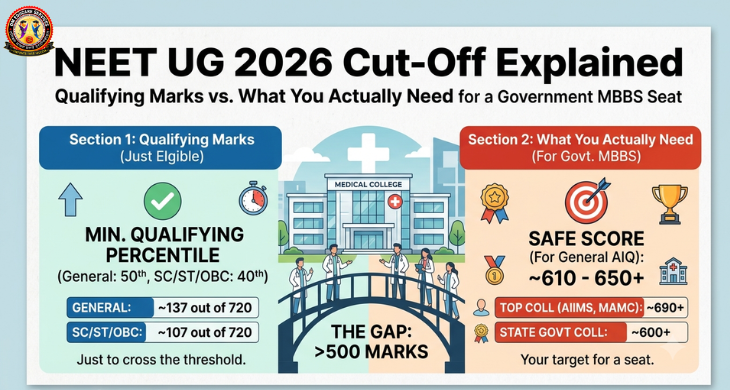
One of the most misunderstood aspects of NEET UG is the difference between the qualifying cutoff and the actual admission cutoff for government medical colleges. Many students assume that scoring above the official qualifying marks means they're on track for a government MBBS seat — but that's far from the truth. The qualifying cutoff only makes you eligible for counselling; it does not guarantee a seat.
With the NEET UG 2026 result and official cutoffs now released by the NTA, this guide breaks down exactly what these numbers mean, how they differ from real admission benchmarks, and what score you actually need to have a realistic shot at a government medical college.
The National Testing Agency released the category-wise qualifying cutoff along with the Re-NEET UG Result on 16th July 2026 at neet.nta.nic.in. Here's the official breakdown: Matrix Academy
| Category | Qualifying Percentile | Cut-off Marks |
|---|---|---|
| UR / EWS | 50th Percentile | 715 – 213 |
| OBC | 40th Percentile | 212 – 177 |
| SC | 40th Percentile | 212 – 177 |
| ST | 40th Percentile | 212 – 177 |
For candidates with disabilities, the UR/EWS-PwBD cutoff stands at 194–212, while OBC/SC/ST-PwBD candidates have a cutoff of 177–193/191.
A Sharp Jump From Last Year
This year's qualifying marks represent a significant increase compared to previous cycles. The qualifying marks for NEET 2025 stood at 144 for General and 113 for reserved categories — meaning the 2026 threshold of 213 for General/EWS is notably higher. This upward shift reflects both the exam's difficulty level and this year's unusual circumstances.
The context behind NEET UG 2026 is unique. The Re-NEET exam was conducted on 21st June 2026 after the original May exam was cancelled. The highest score this year was 715 out of 720, jointly achieved by Aryan Gupta from Punjab and Panshul Bansal from Haryana — notably, no candidate scored a perfect 720/720 this year.
Out of the candidates who appeared for the retest, nearly 20 lakh candidates appeared, and 11.21 lakh qualified for admission to MBBS, BDS, AYUSH, BSc Nursing, and allied medical courses. More than 58% of all qualified candidates are women this year — a notable trend across nearly all participating states and union territories.
This is the single most important distinction every aspirant must understand.
Qualifying Cutoff: The minimum score/percentile required simply to be declared "qualified" and become eligible to register for NEET UG counselling.
Admission Cutoff: The actual opening and closing ranks at which seats are allotted during counselling — and this is dramatically higher than the qualifying threshold. Qualifying the NEET 2026 cutoff does not guarantee admission to an MBBS seat; final admission depends on the counselling cutoff, seat availability, reservation policy, college preference, and candidate rank during the actual counselling rounds. NEET 2026 Cut Off: Category-wise Qualifying Marks, Safe Score, Percentile +2
In simple terms: clearing the qualifying cutoff gets you into the counselling hall. It does not get you a government MBBS seat.
Based on previous-year closing trends and early estimates for the 2026 cycle, here's what aspirants should realistically target for a government MBBS seat:
| Category | Approximate Marks Needed |
|---|---|
| General / EWS | 615 – 630+ marks |
| OBC | ~20 marks lower than General |
| SC | ~70 marks lower than General |
| ST | ~100 marks lower than General |
For context on how competitive the top ranks are this year, industry estimates suggest a rank under 100 requires around 680 marks, a rank under 500 requires around 640 marks, and a rank under 1,000 requires around 620 marks in NEET UG 2026. A rank under 5,000 is achievable with around 580 marks, and a rank under 15,000 with around 552 marks.
Separately, some estimates place the safe score for a seat (across both government and private options combined) somewhat lower — around 555–575 marks for General, EWS, and OBC categories, with the ST category safe score around 450–470 and SC around 465–485 marks. These figures illustrate why students must look beyond the "qualifying" label and plan according to competitive, rank-based realities.
Several factors widen the distance between merely qualifying and actually securing a government seat:
It helps to understand the mechanics behind these numbers. The qualifying percentiles are fixed at 50th for General/EWS, 40th for OBC/SC/ST, 45th for UR-PwD, and 40th for OBC/SC/ST-PwD categories — and these percentile thresholds remain constant every year. What changes annually is the marks corresponding to that percentile, which shifts based on the difficulty level of the exam and the total number of candidates appearing that year.
This is precisely why comparing raw marks year-over-year can be misleading — a 213 in 2026 and a 144 in 2025 both represent the same 50th percentile threshold, just calibrated against different exam difficulty and candidate performance.
The NEET UG 2026 qualifying cutoff — 715–213 for General/EWS and 212–177 for OBC/SC/ST — determines who gets a seat at the counselling table, but it is not a predictor of who gets a government MBBS seat. With expected admission benchmarks of 615–630+ marks for General/EWS candidates (and category-adjusted figures for OBC, SC, and ST), students need to shift their focus from "did I qualify" to "where do I realistically stand for admission." A well-informed, category- and state-aware counselling strategy — built on admission cutoff trends rather than qualifying marks alone — is what ultimately determines success in this competitive cycle.
Confused about where your score places you for government or private MBBS admission? Om Educare's counsellors provide personalized cutoff analysis based on your category, state, and rank — helping you build a realistic, informed counselling strategy.
📞 Call our helpline: 7676610620
📍 Offices in Gurugram, Jamshedpur, Lucknow, Jaipur, and Prayagraj
Om Educare — Empowering Future Doctors.
18-Jul-2026

18-Jul-2026
18-Jul-2026

18-Jul-2026

28-Jun-2026