01-Jun-2026
Author: Om Educare
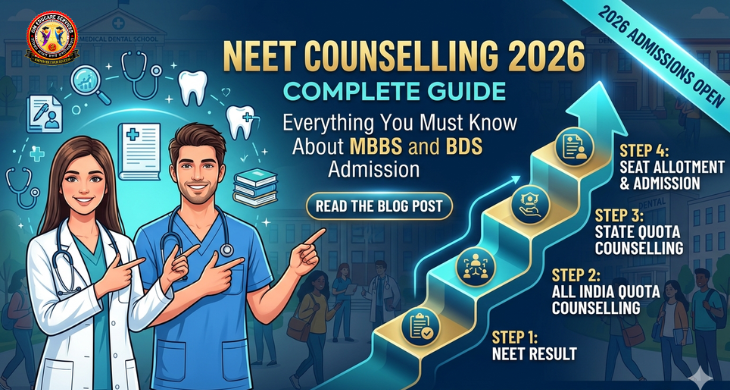
You have cleared NEET. Your score card is in hand. And now everyone around you — family, friends, coaching teachers — is telling you something different about what happens next.
The truth is, most people do not fully understand how NEET counselling actually works. And that lack of understanding costs students seats they genuinely deserved.
At Om Educare, we have guided hundreds of students through this process. This blog is our most complete breakdown of the NEET counselling process — from what it is, to how it works, to how much it costs, to the frauds you must absolutely avoid.
Read this carefully. It could change your outcome.
Let us start from the very beginning.
NEET counselling is the official process through which MBBS and BDS seats are allotted to qualified students. It is entirely computer-driven. Based on your NEET score (merit) and the list of colleges you choose in order of preference — called Choice Filling — the system automatically assigns you a seat.
There is no interview. There is no personal meeting with a college. There is no backdoor.
The only way to get admission into any medical college in India is through counselling. Period.
This is not just a technicality — it is the most important fact every NEET qualifier must understand before anything else.
NEET counselling in India happens through two parallel systems. Understanding both is essential to maximising your chances.
A. Central Counselling — Conducted by MCC (Medical Counselling Committee)
The Medical Counselling Committee conducts central counselling on its official portal mcc.nic.in. This counselling covers some of the most sought-after seats in the country.
What seats fall under MCC counselling?
All India Quota (AIQ): 15% of the total seats in every government medical college across the country are reserved under AIQ. These seats are open to students from all states — meaning a student from Maharashtra can compete for a government college seat in Punjab, and vice versa. This is where the real national-level competition happens.
Deemed Universities: The entire 100% of private seats in all deemed universities across India are filled through MCC counselling. Deemed universities are private institutions with their own fee structures, and they tend to be significantly more expensive than government colleges.
Central Institutions: All AIIMS institutions (100% seats), BHU, JIPMER, AMU, ESIC, and AFMC are part of the MCC counselling process. For most serious NEET aspirants, an AIIMS seat is the ultimate goal — and this is the route to it.
Central Reservation Policy under AIQ:
If you fall under any reserved category, make sure your certificates are valid and up to date before counselling begins. Missing or expired certificates have cost students their reserved seats.
B. State Quota Counselling — Conducted by Each State's Authority
Every state in India has its own counselling authority that manages state-level admissions. This is where the majority of seats are filled.
What seats fall under State Quota counselling?
85% of Government College Seats: After 15% goes to AIQ, the remaining 85% of seats in every state government medical college are filled through that state's own counselling. These seats are primarily for students who are domicile residents of that state.
100% of Private College Seats: All seats in private medical colleges within a state are filled through state counselling. This includes both the management quota and the government-regulated seats in private institutions.
This means that if you want a government MBBS seat, your two and only two options are the All India Quota and your own home state quota. You cannot apply for a government seat in a third state simply because you like that college.
This is one of the most misunderstood areas of NEET counselling. Let us break it down clearly.
Government College Seats: Available only through AIQ (for all-India competition) or your home state quota (for state residents). You cannot claim a government seat in any state other than your own through state counselling.
Semi-Government or Aided College Seats: These are technically private colleges but operate under government fee regulation — meaning fees are significantly lower than fully private colleges. However, these seats are strictly reserved for domicile residents of that state. If you are not a bonafide resident of that state, you are not eligible.
Private College Seats: Here, the rules open up slightly. Apart from your home state, you can also participate in what are called Open States — states that allow students from other states to apply for seats in their private medical colleges. This significantly expands your options if a government seat is out of reach.
Understanding which states are open and which colleges fall under which category is something that changes every year. This is exactly where personalised counselling guidance from Om Educare makes a tangible difference.
NEET counselling happens across four rounds:
Round 1 → Round 2 → Round 3 → Stray Vacancy Round
Each round has its own registration window, choice filling period, seat allotment result, and reporting deadline. Missing any one of these windows — even by a single day — can mean losing your allotted seat.
Here are the rules every student must know:
The Round 3 Lock-In Rule: If a student accepts and reports to a seat allotted in Round 3 of either central or state counselling, they are permanently locked into that seat. They cannot participate in any further counselling rounds, cannot upgrade to a better college, and cannot withdraw without losing their seat entirely. This rule exists to prevent seat blocking in the final round.
The Stray Vacancy Round: After Round 3, seats that remain unfilled for any reason — withdrawals, no-shows, document failures — are pooled together and offered in a final Stray Vacancy Round. Many students with relatively lower ranks have secured excellent government seats simply by staying alert during this round. At Om Educare, we track this round carefully for every student we are guiding.
Security Deposit Rules: To participate in counselling, every candidate must pay a security deposit in advance. For government college counselling, this amount is relatively modest. For private and deemed university counselling, it ranges from Rs 1 lakh to Rs 5 lakh depending on the authority.
Critically — if you are allotted a seat in Round 2 or later and you choose not to report, your security deposit is forfeited. This is a real financial risk that students must account for when deciding whether to wait for upgrades.
Choice filling is arguably the most important step in the entire counselling process. A poorly filled choice list is one of the biggest reasons students end up in colleges they never wanted.
Here is the fundamental principle: Always fill your choices in the genuine order of your preference — not in the order of what you think you will get.
Put AIIMS Delhi at the top if that is your dream, even if your rank is 50,000. The computer will simply skip past it if your rank is not competitive enough. There is absolutely no disadvantage to putting a top college first.
What you must avoid is reverse engineering your choices based purely on last year's cutoffs and filling only "safe" options. Cutoffs shift every year. Students who play it too safe often miss seats they could have gotten.
Build your choice list with a clear top tier (aspirational), a middle tier (realistic), and a bottom tier (backup) — and cover enough colleges across all tiers so that you always have a safety net.
One of the most practical conversations any family must have during counselling is around budget. Here is an honest breakdown:
Government College (MBBS or BDS): Total cost of the entire course, including tuition, hostel, and miscellaneous expenses, typically ranges from Rs 2 lakh to Rs 10 lakh over five and a half years. This is why a government seat is so fiercely competitive.
Private and Deemed University (MBBS): This is where the numbers become significant, and they vary based on your NEET score.
Students with strong scores who are competitive for better private colleges typically look at a minimum budget starting around Rs 50 lakh for the full course. As scores decrease and the available college options become more limited, fees rise sharply. For scores in the range of 250 to 400, total course costs can range from Rs 65 lakh to Rs 80 lakh, and in some cases reach Rs 1.5 crore to Rs 2 crore at the lower end of deemed universities.
Private College (BDS): BDS in a private college is significantly more affordable than MBBS. Total costs including hostel typically start from Rs 6 to 7 lakh at the lower end and go up to Rs 40 to 50 lakh for premium institutions. Good quality private BDS colleges are often available in the Rs 20 to 25 lakh range.
Budget planning is not just about total fees. It also includes security deposits, hostel advance payments, mess fees, travel, and incidental costs — all of which add up over five and a half years.
Every year without exception, students and families fall victim to counselling fraud. This section could be the most important one you read.
There is no such thing as Direct Admission to MBBS. If anyone — an agent, a consultant, a self-proclaimed college representative — tells you they can get you a direct government MBBS seat without counselling, they are lying. No college in India has direct control over its own seat allotment. Every single seat is filled through the computerised counselling process.
Fake Domicile Certificates are a career-ending risk. Some fraudsters offer to arrange a fake domicile or residence certificate for a state you do not actually belong to, promising a government seat in that state. Students who have taken this route have had their admissions cancelled after verification, faced legal action, and lost years of their life to legal battles. The risk is simply not worth any amount of promised benefit.
Low score, government seat promises are always fraud. If your score genuinely qualifies you for a government seat, the counselling process itself will reflect that. No external agent can change your merit rank or manipulate a computerised system. Anyone claiming otherwise is attempting to defraud you.
At Om Educare, we believe in complete transparency. We will always tell you exactly what your score qualifies you for — honestly and accurately — so you can make decisions based on real information, not false hope.
NEET counselling is the only route to any medical college admission in India. It runs through two systems — MCC (central) and state counselling authorities. Government seats are available only through AIQ and your home state. Private seats have wider options including open states. Counselling happens in four rounds, and Round 3 locks you in permanently. Budget planning is essential — government college costs are vastly different from private college costs. And no genuine seat can ever be obtained through an agent or direct admission promise.
Our counselling support at Om Educare is not a template. It is built entirely around your rank, your category, your state, your budget, and your goals.
We help you understand every quota you are eligible for. We help you build a smart, well-structured choice list. We track every round and every notification so you never miss a window. We verify your documents before you reach the verification stage. And we are available throughout the process when the pressure is highest and the decisions matter most.
Your NEET preparation took years. Your counselling takes weeks. But those weeks determine everything.
Get in touch with Om Educare today for personalised NEET Counselling 2026 guidance.
Om Educare — Empowering Future Doctor
18-Jul-2026
18-Jul-2026

18-Jul-2026
18-Jul-2026
18-Jul-2026