29-May-2026
Author: Om Educare
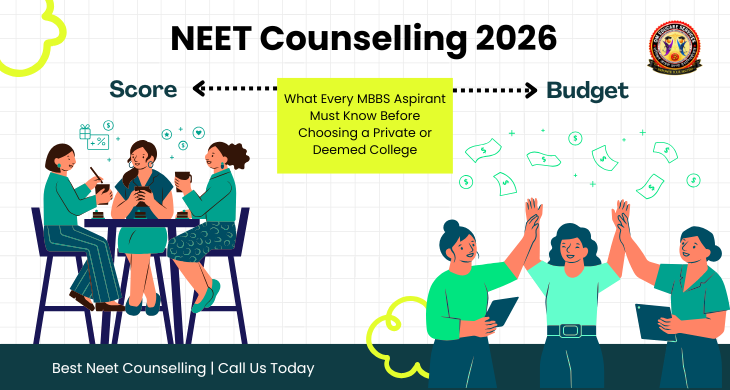
Every year, right after NEET results are announced, our phones don't stop ringing. Students are anxious. Parents are confused. And almost everyone is asking the same two questions:
"What is my score good enough for?" "How much will it cost?"
These are the right questions — but most families don't realise that the answer to both depends entirely on how these two factors relate to each other. In this blog, we break down the Score vs Budget equation that drives every private and deemed MBBS admission in India, and what it means for your planning in 2026.
Before we dive in, let's clear up one of the most common sources of confusion we see every year.
Admissions are NOT based on your NEET score. They are based on your All India Rank.
Your rank is determined not just by how many marks you scored, but by how every other student performed on that same paper. A score of 500 could give you a rank of 80,000 in a relatively easier year — or a rank of 60,000 in a tougher one. This is why planning based purely on your predicted score, before the actual rank is out, is always approximate.
Once the official rank is declared, precise planning begins. Until then, use your estimated score as a rough guide — not a guarantee.
Let's be honest about something most people don't say out loud: very few students choose private or deemed colleges out of preference. Most come to us after they have missed a government college seat by a few ranks, or realised early that their score won't make the state or All India Quota cutoff.
This is not a failure. This is a decision point — and it requires a clear head, honest information, and the right strategy.
The good news: India has hundreds of NMC-recognised private and deemed medical colleges offering the same MBBS degree, the same licensing exam, and the same career path. The challenge is knowing which ones are worth your time, money, and five and a half years of your life.
After years of counselling thousands of families, we have identified four distinct situations that students fall into. Here is what each one means for your admission options.
If your score is strong — even if it falls just short of the government college cutoff — and your budget is limited, you are actually in a very workable position.
Students in this category can target well-reputed private colleges in states like Kerala, Karnataka, Chhattisgarh, or select colleges in Uttar Pradesh, where the fee structure is more regulated and transparent. A good rank gives you leverage. You are not dependent on management quota — you can compete for merit-based private seats where fees are significantly lower.
Our advice: Don't rush. Map out colleges state by state, understand the counselling timelines, and participate in multiple rounds. Your score is your asset — use it strategically.
If you are just NEET-qualified — meaning you cleared the minimum qualifying marks but your rank is not competitive for government seats — and budget is not a constraint, a confirmed MBBS seat in India is very much within reach.
High-fee private colleges, premium deemed universities, and NRI quota seats across states like Karnataka, Maharashtra, Tamil Nadu, and Rajasthan are accessible at this score level. These colleges have lower cutoffs precisely because their fees are higher, which keeps demand lower among the general pool of applicants.
Our advice: Be selective about quality. A high fee does not always mean a good college. Let us help you shortlist institutions that are worth the investment — not just those with available seats.
This is the category most students fall into, and it requires the most careful planning.
With a limited score and a moderate budget, your options are narrower — but they exist. States like Bihar, Uttar Pradesh, and select North East colleges offer total budgets in the ₹65–90 lakh range for students with scores around 350–450. Andhra Pradesh and Telangana are also worth exploring for students open to studying in South India.
The key in this scenario is not to waste time waiting for a perfect option that may not come. Move early, participate in multiple state counsellings, and accept that some compromise on college reputation may be necessary.
Our advice: Be realistic about what the combination of your score and budget can deliver. A good counsellor will tell you the truth — not just what you want to hear.
We will be direct because we believe you deserve honesty over false hope.
If your NEET score is very low and your total budget is under ₹60–70 lakhs, the chances of getting a legitimate, NMC-recognised MBBS seat in a decent college in India are extremely slim. If anyone promises you otherwise — a confirmed seat at a reputed college for a very low score and a very low budget — that is almost certainly a scam or a college so below average that the quality of your medical education will be seriously compromised.
In this situation, we recommend an honest conversation about your options: a strategic NEET retake in 2027 with a structured preparation plan, BDS as a genuine alternative career path, or MBBS abroad in select NMC-approved countries. None of these are dead ends — but they require a clear decision made without panic.
Our advice: Don't let desperation make decisions for you. Come speak to us. We will map out every real option available and help you choose wisely.
One thing our counsellor Prabhakar Bharati frequently highlights is that central and state governments have very limited oversight over private medical college fee structures — and this problem is most acute in North India.
Despite producing the highest number of NEET aspirants in the country, states in North India often have the least regulated private college fee environments, with significant hidden charges that families discover only after the admission process is underway. This makes it critical to get the complete, written fee breakdown from any college before committing — not just the headline number quoted by an agent or on a brochure.
Here is a practical snapshot based on 2024 data and current trends for 2026 planning:
Score around 465 | Budget ₹70 lakhs: UP and Bihar private colleges are a strong fit. If open to South India, Andhra Pradesh and Telangana offer good options at this budget. Tripura Medical College in the North East is also worth considering. Jharkhand colleges can be skipped at this score range as better alternatives exist.
Score 350–450 | Budget ₹80–90 lakhs: Bihar (select colleges), UP, Tripura, and Manipur (Shija Academy) are realistic targets.
Score below 300 | Budget ₹1 crore+: Deemed universities in Tamil Nadu and Pondicherry, North East colleges, and management quota seats in Karnataka and Maharashtra become viable.
Score just qualifying | Budget ₹1.5 crores+: Premium deemed universities, NRI quota and Institutional quota seats in Maharashtra and Karnataka are accessible regardless of rank.
Our counsellor's core advice for every student: don't wait for the result to start preparing.
Use this window to:
Once your official All India Rank is declared, precise counselling can begin. That is when we sit with you, map every realistic option against your rank and budget, and build a step-by-step plan to get you to a confirmed seat.
The Score vs Budget equation is not just a financial calculation — it is about making the best possible decision for the next five and a half years of your life and the decades of medical practice that follow.
At Om Educare, we have guided hundreds of students through exactly this process — students who thought they had no options, families who were ready to give up, and aspirants who simply needed the right information to make the right move.
We do not promise what we cannot deliver. We do not sugarcoat difficult realities. What we do is stand with you, give you the full picture, and make sure every option available to you is on the table.
If your NEET results are around the corner and you want to understand exactly where you stand — call our team today.
Toll-Free: 7676610620 Offices in Gurugram | Jamshedpur | Lucknow | Jaipur | Prayagraj
18-Jul-2026
18-Jul-2026

18-Jul-2026
18-Jul-2026

18-Jul-2026