20-May-2026
Author: Om Educare
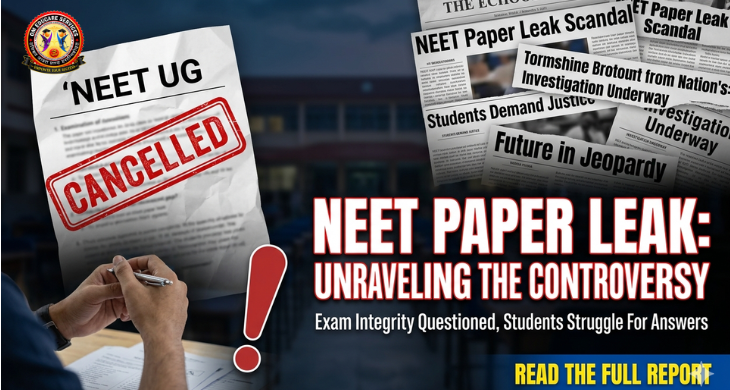
Every year, millions of students pour their hearts into preparing for NEET. Sleepless nights, endless revisions, and years of dedication — all riding on a single exam. Yet for the past decade, that dream has been repeatedly shaken by one recurring nightmare: paper leaks.
At Om Educare, we believe our students deserve a system that is as hardworking and honest as they are. That's why today we're breaking down the real problem, the proposed solutions, and what we think is the most practical path forward.
Over the last 10 years, nearly 89 major paper leak cases have been reported across India. This is no longer just an exam management issue — it has become a national governance and trust crisis. When students lose faith in the fairness of the system, the entire purpose of merit-based selection collapses.
The 2024 NEET controversy was a stark reminder of this. Centres in Patna and Sikar (Rajasthan) saw suspiciously inflated scores and abnormal performance patterns, leading to serious allegations of paper leaks. The outrage that followed shook the entire medical education system.
In response to growing pressure, the Education Ministry has proposed shifting NEET to a Computer Based Test (CBT) format from 2027. On the surface, it sounds modern and secure. But when you look closely, this solution brings its own serious set of problems.
Infrastructure Gap: Arranging computers, labs, and power backup for 22 to 25 lakh students across India is an enormous challenge. The exam would need to be conducted in 10 to 12 shifts just to accommodate everyone.
Rural Students Left Behind: A large portion of NEET aspirants come from villages and small towns where computer access and familiarity is limited. Shifting to CBT puts these students at an immediate disadvantage — not because of their knowledge, but because of their geography.
Cybersecurity Risks: Moving online doesn't eliminate cheating — it just changes its form. Servers can be hacked, remote access tools can be exploited, and data can be manipulated in ways that are harder to trace than a physical paper leak.
The Normalisation Controversy: With multiple shifts comes the inevitable debate over paper difficulty. Different shifts, different difficulty levels — and with that comes normalisation disputes, court cases, and widespread student dissatisfaction. JEE aspirants have lived this reality for years.
Education expert Prabhakar Bharati has proposed a model that we at Om Educare find genuinely compelling — keep NEET offline (Pen & Paper), but completely reimagine the printing and distribution process. Instead of printing and transporting papers weeks in advance (which is where leaks happen), compress the entire process into just a few hours on exam day itself.
Here's how it works, using 2 May 2027 as an example:
March 2027 — Building the Question Bank
Four separate subject experts — one each for Botany, Zoology, Physics, and Chemistry — prepare 10 different sets of 45 questions each. This creates a secure question bank of 1,800 questions, which is submitted to NTA well in advance. At this stage, no single person knows which questions will appear in the actual exam.
April 2027 — Preparing the Strong Rooms
Every exam centre is equipped with a dedicated Strong Room fitted with high-speed printers, secure servers, and scanners. This is a one-time infrastructure investment that can be reused for every government exam — SSC, Railways, PCS — conducted on subsequent Sundays.
Exam Day — The Timeline
11:00 AM: Technical teams are deployed inside the Strong Rooms. A dummy paper trial run is conducted to test internet connectivity and printer functioning. Everything is verified and ready.
12:00 PM: At NTA's central control room, Artificial Intelligence randomly selects 180 questions from the 1,800-question bank to create a unique paper. Subject experts present at the control room verify the paper for accuracy, balance, and correctness. Simultaneously, all Strong Rooms across the country are sealed — with the support of security forces or signal jammers — so that no information can exit or enter.
1:00 PM: Student entry is completely stopped. The encrypted question paper is transmitted from NTA's secure server to all exam centres. Over the next 30 minutes, high-efficiency printers print and seal the exact number of paper sets required at each centre.
2:00 PM: Papers are distributed directly to classrooms. The exam begins on time.
5:00 PM: As soon as the exam ends, OMR sheets are brought to the Strong Room and scanned immediately using high-speed scanners.
Within 1 to 2 hours, each student receives a scanned copy of their OMR sheet on their registered email ID. A secure copy is simultaneously uploaded to a government server such as NIC. This single step eliminates the possibility of OMR manipulation — one of the most common forms of post-exam fraud.
The biggest concern with any reform is cost. But this model requires only a one-time investment in printers and scanners at each exam centre. Once set up, the same infrastructure can be used every single week for government and state-level recruitment exams. The cost recovers itself quickly, and the system keeps delivering value for years.
We have seen firsthand how paper leaks and exam controversies devastate students — not just their ranks, but their confidence, their mental health, and their trust in the system. A student who prepares for two or three years deserves an exam that is fair, transparent, and beyond doubt.
The CBT route, while well-intentioned, is not the answer India needs right now. A reformed, technology-assisted offline model — where the paper is born just hours before the exam — is practical, scalable, and leak-proof.
We hope policymakers seriously consider solutions like this. And until the system changes, Om Educare will continue doing what we do best — preparing our students to face any exam, under any system, with full confidence.
18-Jul-2026
18-Jul-2026

18-Jul-2026
18-Jul-2026

18-Jul-2026