22-Jun-2026
Author: Om Educare
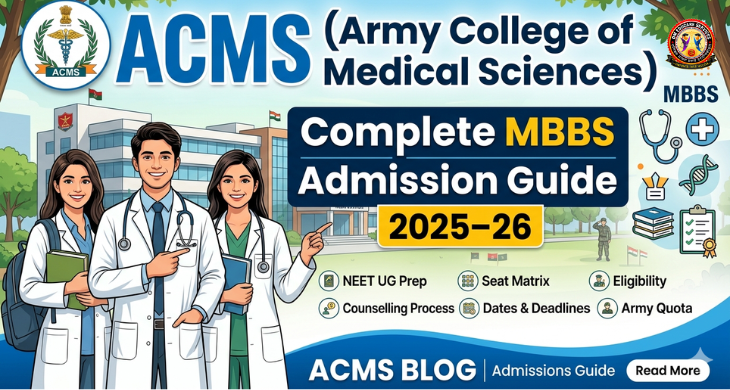
For thousands of NEET aspirants across India, Army College of Medical Sciences (ACMS) in New Delhi represents a unique aspiration — the chance to pursue an MBBS degree in a prestigious, disciplined, and fully supported environment tied to the Indian Army. With a sprawling campus backed by Base Hospital Delhi Cantonment, ACMS offers not just a medical education but a life of purpose, service, and structured excellence.
Yet every year, parents and students arrive at counselling centres like Om Educare confused about one fundamental question: How exactly does admission to ACMS work? This blog is a comprehensive answer to that question.
Army College of Medical Sciences (ACMS), located in Delhi Cantonment, New Delhi, is an autonomous medical college affiliated with Guru Gobind Singh Indraprastha University (GGSIPU). It is run under the aegis of the Army Welfare Education Society (AWES) and is primarily designed to serve the educational needs of the wards of Army personnel.
The college is attached to Base Hospital Delhi Cantonment, one of the premier military hospitals in the country, offering students unmatched clinical exposure from the very first year.
Key Facts at a Glance:
| Parameter | Details |
|---|---|
| Full Name | Army College of Medical Sciences |
| Location | Delhi Cantonment, New Delhi – 110010 |
| Affiliated University | Guru Gobind Singh Indraprastha University (GGSIPU) |
| Managed By | Army Welfare Education Society (AWES) |
| Total MBBS Seats | 100 per batch |
| Attached Hospital | Base Hospital Delhi Cantonment |
| Recognition | NMC (National Medical Commission) Recognised |
| Course Duration | 5.5 Years (4.5 years + 1 year internship) |
Understanding eligibility is the first and most critical step. ACMS admission is reserved for wards (children) of Army personnel, and the priority category as prescribed by AWES is applicable at the time of admission. This makes ACMS structurally different from most other medical colleges in India — it is not a general open-merit institution for civilians.
Who Qualifies as a "Ward"?
"Ward" means a legitimate child — son or daughter — who is financially dependent on the Army personnel. Adopted children may require additional documentation. Spouses are generally not eligible under the ward category.
Academic Eligibility (Applicable to All Candidates):
This is the section that most blogs and agents get completely wrong — and it is the most important part of the ACMS admission structure. ACMS does not simply rank all Army ward candidates together on a single merit list. Instead, it follows a defined priority order prescribed by AWES, which determines who gets preference regardless of NEET score within the same rank bracket.
Understanding your priority category is as important as knowing your NEET score.
The Official AWES Priority List for ACMS MBBS Admission 2026–27:
Priority I — Widows and children of defence personnel martyred in war
The highest priority is given to families of those who made the ultimate sacrifice on the battlefield. Widows and children of Army personnel killed in active war conditions fall under this category and receive first preference in seat allotment.
Priority II — Widows and children of war-disabled personnel
This covers widows and children of personnel who were disabled during war and have been released from service while receiving a disability pension. Their sacrifice and continued disability earn them the second-highest priority in admission.
Priority III — Widows and children of personnel martyred in service during peacetime
Personnel who lost their lives during peacetime service — where the death is attributable to military service — are honoured through this priority. Their widows and children receive the third preference in the admission process.
Priority IV — Widows and children of personnel disabled during peacetime
Soldiers who sustained disabilities during peacetime service — and whose disability is connected to military duties — are covered under this priority. Their dependents receive the fourth preference.
Priority V — Children of Gallantry Award recipients
Children of soldiers who have been honoured with gallantry awards receive the fifth priority. This includes prestigious awards such as Param Vir Chakra, Ashok Chakra, Vir Chakra, Sena Medal, and other officially recognised gallantry decorations.
Priority VI — Children of serving Army personnel with minimum 10 years of continuous service
This is the largest group of applicants each year. Children of currently serving Army personnel — Officers as well as JCOs and ORs — who have completed a minimum of 10 years of continuous service are eligible under this priority. This is Priority VI, meaning the five categories above them receive preference if seats are being filled.
Priority VII — Children of ex-servicemen with regular pension
Children of retired Army personnel who are drawing a regular pension from the government fall under Priority VII. Ex-servicemen who retired honourably and receive pension benefits can have their children apply under this category.
Priority VIII — Wards of all other eligible serving and ex-servicemen, and non-Army/civilian candidates
The final and broadest category covers all remaining eligible candidates — including wards of Army personnel who may not fit neatly into Priorities I through VII, as well as civilian candidates whose parents have no Army background. This is the most competitive category given the limited seats available after higher priorities are filled.
Why Does This Priority System Matter?
Imagine two candidates — both with a NEET score of 550. Candidate A is the child of a soldier martyred in war (Priority I). Candidate B is the child of a serving soldier with 12 years of service (Priority VI). Even though their scores are identical, Candidate A will receive preference over Candidate B because of the priority system.
This means that simply having a high NEET score does not guarantee admission if seats in your priority category have already been filled. Know your priority. Know your competition within that priority.
The 100 MBBS seats at ACMS are distributed across the priority categories described above, with further sub-divisions based on rank within the Army. The exact seat distribution is published in the official ACMS/AWES notification each year.
Approximate Seat Distribution (Subject to Annual Revision):
| Category | Approximate Seats |
|---|---|
| Priority I to V (Martyr, War Disabled, Gallantry categories) | ~8–12 (combined) |
| Priority VI — Serving Personnel Wards (Officers) | ~25–30 |
| Priority VI — Serving Personnel Wards (JCO/OR) | ~30–35 |
| Priority VII — Ex-Servicemen Wards | ~8–12 |
| Priority VIII — Civilian / Remaining Categories | ~10–15 |
| SC/ST/OBC/EWS/PwD Reservation | As per Government norms (horizontal) |
Note: These figures are approximate and based on recent trends. The exact seat matrix is revised and published each year by AWES/ACMS. Always verify from the official ACMS notification for the year of your application.
ACMS follows its own independent admission process, separate from MCC (Medical Counselling Committee) and most state counselling bodies. Here is how it works:
Step 1: Appear in NEET UG and Qualify
Everything begins with NEET UG. There is no separate entrance exam for ACMS. Your NEET score is the sole academic basis for ranking within your priority category. The higher your NEET score, the stronger your position.
Without a valid NEET UG scorecard, no application to ACMS is possible.
Step 2: Watch for the Official ACMS Notification
ACMS releases its own admission notification, typically between July and September, after NEET UG results are declared. This notification is published on the official ACMS website, through AWES channels, and via Army Record Offices and Unit Headquarters for Army ward candidates.
The notification contains the seat matrix, application form link, required documents list, last date to apply, and all important dates for merit list declaration and counselling.
Do not rely on third-party websites or agents. Always cross-check with the official ACMS/AWES source.
Step 3: Fill the Online Application Form
Candidates must register and fill the online application form on the ACMS/AWES portal. Key details include personal and academic information, NEET UG roll number and score, priority category selection, and for Army wards — details of the Army personnel such as service number, rank, and unit. A non-refundable application fee is charged at this stage.
Step 4: Document Submission and Verification
This step is critical and often where candidates face rejection or delays due to incomplete paperwork.
Documents Required for Army Ward Candidates:
Documents Required for Civilian / Priority VIII Candidates:
⚠️ Om Educare Advisory: The Relationship Certificate must be obtained from the correct authority — usually the Record Office or the Unit CO. An incorrect or outdated certificate is a common reason for disqualification. Additionally, candidates in Priority I through V must ensure they have the correct supporting documents — death certificates, disability papers, and gallantry award certificates — well in advance. Start this process immediately after NEET results, not after the notification drops.
Step 5: Merit List Declaration
ACMS publishes separate merit lists for each priority category. Rankings within each list are based purely on NEET UG scores, with ties broken by NEET's internal tie-breaking policy. There is no additional aptitude test, interview, or personality round.
Because lists are priority-wise, a candidate in Priority VIII with a score of 600 will not displace a candidate in Priority I with a score of 500. Priority category comes first. NEET score operates within the priority.
Step 6: Counselling and Seat Allotment
Shortlisted candidates are called for counselling — online or offline depending on the year's guidelines. During counselling, original documents are verified, candidates confirm their willingness to accept the allotted seat, and provisional allotment letters are issued.
Step 7: Payment of Fees and Reporting to College
Upon receiving the allotment letter, selected candidates must pay the first-year fees within the stipulated deadline and report to ACMS with all original documents on the designated date. A medical fitness examination is conducted as a standard requirement. Failure to report within the deadline results in automatic forfeiture of the seat.
One of the most attractive features of ACMS is its fee structure, which is significantly lower than private medical colleges and deemed universities.
| Fee Component | Approximate Amount (Per Year) |
|---|---|
| Tuition Fee (Army Ward — Officers) | ₹1,50,000 – ₹2,00,000 |
| Tuition Fee (Army Ward — JCO/OR) | ₹1,00,000 – ₹1,50,000 |
| Tuition Fee (Priority VIII / Civilian) | ₹4,00,000 – ₹6,00,000 |
| Hostel / Accommodation | ₹50,000 – ₹80,000 (approx.) |
| Other Fees (Library, Lab, Exam) | ₹20,000 – ₹40,000 |
Note: Fee structure is revised annually. The above figures are approximate and based on recent trends. JCO/OR wards particularly benefit from heavily subsidised fees — one of the most meaningful welfare provisions ACMS extends to soldiers' families.
ACMS follows a combination of institutional priority reservation (AWES categories) and Government of India reservation norms applied horizontally across all categories:
A question that frequently arises at Om Educare counselling sessions: Do ACMS graduates have to join the Army?
The answer for most candidates is — not mandatorily. However, there is typically a bond/service agreement at the time of admission requiring students to complete their mandatory 1-year internship at Base Hospital Delhi Cantonment or attached facilities. Students who leave mid-course may be required to refund fees and pay a penalty as per the bond terms.
Army ward candidates may be encouraged to apply for Short Service Commission (SSC) in the Army Medical Corps (AMC) after graduation, but are not legally bound to serve unless a specific bond has been signed.
Always read the bond document carefully before signing. If in doubt, contact Om Educare.
At Om Educare, we have seen students fall prey to misinformation and fraud when applying to niche colleges like ACMS. Here are the most common pitfalls:
Fake Agents Promising "Guaranteed ACMS Seats"
No agent, consultant, or middleman can guarantee a seat at ACMS. Seats are allotted based on NEET merit within priority categories. Anyone promising a seat in exchange for money is committing fraud.
Incorrect Priority Category Claims
Some candidates attempt to claim a higher priority category with fabricated or borrowed documents — for example, falsely claiming Priority I or Priority III status. This is a criminal offence and results in permanent disqualification, cancellation of admission, and potential legal action.
Missing the Notification Window
Because ACMS releases its own notification independently — not through MCC — students who are only tracking MCC counselling dates often miss the ACMS application window entirely. Bookmark the ACMS and AWES official websites and set reminders from July onwards.
Incomplete Document Preparation
The Relationship Certificate and priority-specific supporting documents — disability papers, gallantry certificates, death certificates — take time to obtain from Army units and Record Offices. Starting this process after the notification is released is often too late.
| Feature | ACMS, Delhi | AFMC, Pune |
|---|---|---|
| Open to Civilians | Yes (Priority VIII) | No — Defence only |
| Admission Basis | NEET + AWES Priority | NEET + AFMC merit |
| Bond / Service | Soft bond (internship) | Mandatory Army service |
| Fee | Subsidised for Army wards | Fully funded (with bond) |
| Affiliation | GGSIPU | Defence University / MUHS |
| Location | Delhi Cantonment | Pune Cantonment |
| Priority System | 8-level AWES priority | Fixed defence eligibility |
Navigating the ACMS admission process — especially understanding your priority category, gathering the right documents, and tracking the independent notification — requires precision and timely action. At Om Educare, we:
Call us today: 📞 7676610620
Offices in Gurugram | Jamshedpur | Lucknow | Jaipur | Prayagraj
ACMS is one of India's most respected and unique medical institutions — offering a disciplined environment, strong clinical training, and deeply subsidised education to the families of those who serve and sacrifice for the nation. The AWES priority system ensures that those who have given the most — martyrs' families, war-disabled soldiers, gallantry award recipients — are honoured first in the admission process.
But this system also means that understanding your exact priority category is not optional — it is essential. A student who does not know their priority, or who applies with incorrect documents, loses a seat they may have rightfully deserved.
Start early. Know your priority. Prepare your documents. And do not fall for any agent promising guaranteed seats.
If you are serious about ACMS in 2026–27, reach out to Om Educare. We will help you navigate every step — from priority identification to document preparation to counselling — with transparency, expertise, and no false promises.
Om Educare — Empowering Future Doctors
18-Jul-2026
18-Jul-2026

18-Jul-2026
18-Jul-2026
18-Jul-2026