19-Jun-2026
Author: Om Educare
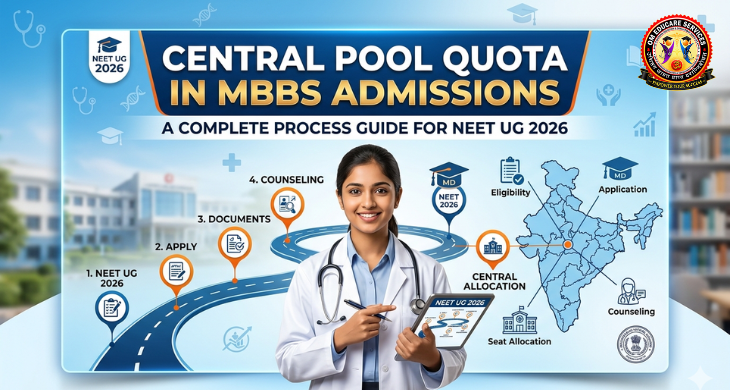
When most NEET aspirants think about MBBS admission routes, three categories typically come to mind: the All India Quota, State Quota, and Management Quota. But there's a fourth, smaller, and far less understood category that quietly opens doors for a specific group of candidates — the Central Pool Quota. If you belong to a state or Union Territory without its own medical college, or fall under one of a handful of special categories the Government of India has chosen to protect, this quota could be the route that gets you into MBBS.
At Om Educare — Empowering Future Doctors — we regularly meet families who've never even heard of the Central Pool Quota until they realise their home state has no medical college of its own. This guide breaks down exactly what it is, who qualifies, and how the admission process works.
The Central Pool Quota (CPQ) is a small reserved pool of MBBS and BDS seats, contributed voluntarily by various state governments and medical institutions, set aside specifically for candidates who would otherwise have no real opportunity to compete for a state quota seat. The defining idea behind this quota is fairness: a candidate from a state or Union Territory that has no medical college of its own cannot realistically compete for "state quota" seats anywhere, since state quota seats are reserved for residents of the state where the college is located. The Central Pool exists to close that gap.
The Central Pool Quota is administered as part of the broader counselling machinery run by the Directorate General of Health Services (DGHS) on behalf of the Medical Counselling Committee (MCC), which also handles the 15% All India Quota and admissions to central institutions like AIIMS, BHU, JIPMER, and AMU.
Eligibility for the Central Pool Quota isn't based on NEET score alone — it's based on belonging to one of a defined set of categories. The main groups that typically qualify include:
Candidates from States/UTs Without Their Own Medical College
This is the core category. If your home state or Union Territory does not have a government medical college of its own, you have no state quota to apply to — so a share of seats from the Central Pool is reserved for candidates from these regions specifically.
Union Territories Without Medical Colleges
Several Union Territories fall into the same situation as states without medical colleges, and candidates domiciled there are similarly eligible for CPQ consideration, alongside their eligibility for the 15% All India Quota.
Children/Wards of Central Armed Police Forces and Paramilitary Personnel
A defined number of seats within the Central Pool are reserved for the children of personnel serving in central paramilitary and armed police forces, recognising their unique service circumstances and the lack of a fixed "home state" many of these families experience due to frequent transfers.
Tibetan Refugees
A specific allocation within the Central Pool is reserved for Tibetan refugees residing in India, a long-standing humanitarian provision recognised by the Government of India.
Victims of Terror Attacks and Communal/Naxal Violence (and their dependents)
Spouses and children of victims of terror attacks, as well as those affected by communal violence and Left Wing Extremism (Naxal violence), are eligible for reserved seats within the Central Pool, in line with directives from the Ministry of Health and Family Welfare to state governments.
Because eligibility is category-specific and the exact list of contributing states and seat numbers changes from year to year (depending on voluntary contributions), it's essential to check the current year's official notification rather than rely on last year's seat matrix.
Step 1: Qualify NEET UG
As with every other quota, there is no admission route into MBBS without first qualifying NEET UG. The Central Pool Quota does not offer any relaxation on this requirement — your NEET UG score and rank remain the foundation of your eligibility.
Step 2: Register for Counselling Through MCC
Central Pool Quota seats are filled through the centralised counselling process conducted by DGHS/MCC, the same body that conducts the 15% AIQ counselling. Candidates need to register on the official MCC counselling portal once registration opens.
Step 3: Submit a Category Declaration
Since CPQ eligibility depends on your specific category — state/UT of domicile, paramilitary dependent status, Tibetan refugee status, or victim-of-violence status — candidates typically need to submit a self-declaration and supporting documentation establishing which category they fall under. This is also where many state/UT candidates without a medical college submit declarations confirming their domicile status, similar to the self-declaration process used for AIQ counselling from certain Union Territories.
Step 4: Choice Filling
Once registered and verified, eligible candidates fill their college and course preferences from the list of participating institutions offering Central Pool seats for that year, exactly as they would for AIQ choice filling.
Step 5: Seat Allotment Based on Merit and Category
Allotment within the Central Pool Quota is merit-based — among candidates eligible for a particular CPQ category, NEET UG rank determines who gets priority. Because this is a relatively small, defined pool of seats competing only among eligible candidates within each category (not the entire 23+ lakh NEET UG applicant pool), the effective competition is narrower than general AIQ or state quota seats — though this varies significantly by category and year, so it should never be assumed in advance.
Step 6: Document Verification and Reporting
As with every other quota, allotted candidates must report to the allotted institute within the specified window with all original documents — NEET scorecard, admit card, Class 10 and 12 certificates, domicile/category-specific proof, and identity documents — for final verification before admission is confirmed.
While the exact document list depends on which CPQ category you're applying under, candidates should generally be prepared with their NEET UG admit card and scorecard, Class 10 and 12 mark sheets and certificates, a valid domicile or residence certificate for their home state/UT (where applicable), category-specific proof — for example, a service certificate for paramilitary dependents, refugee registration for Tibetan refugee candidates, or an official victim/dependent certificate issued by the relevant authority for terror or communal violence categories, and standard identity proof such as Aadhaar or passport.
Because category-specific documents are scrutinised carefully — much like domicile and caste certificates in state quota counselling — it's important that every certificate is obtained from the correct issuing authority well in advance of counselling, rather than arranged hastily at the last moment.
As we've covered in our previous blogs on document and certificate fraud in NEET counselling, any quota with specific, narrowly defined eligibility criteria becomes a target for agents promising "easy" qualification through manufactured documents. The Central Pool Quota is no exception. If you don't genuinely belong to one of the eligible categories — a state/UT without a medical college, a paramilitary dependent, a Tibetan refugee, or a recognised victim/dependent of violence — no certificate obtained through an agent will hold up under the verification process, and submitting one carries the same serious legal risk as fraud in any other quota category.
The Central Pool Quota is genuinely useful for the right candidates, but it's also one of the most misunderstood quotas in the entire NEET counselling system — many eligible students don't even realise they qualify, while others waste time pursuing it without genuine eligibility. At Om Educare, we help families understand exactly which quotas they're eligible for — Central Pool, AIQ, State Quota, NRI, or Management Quota — and guide them through registration, document preparation, and choice filling with complete transparency.
If you're unsure whether you qualify for the Central Pool Quota, or want expert guidance through NEET UG 2026 counselling, reach out to our team today.
18-Jul-2026
18-Jul-2026

18-Jul-2026
18-Jul-2026
18-Jul-2026