15-Jun-2026
Author: Om Educare
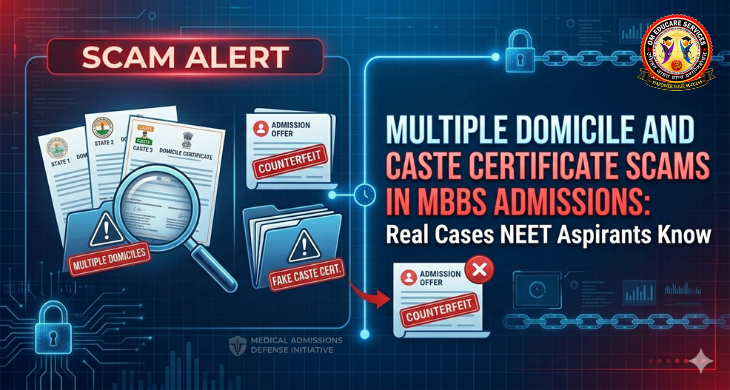
Every NEET UG counselling cycle, state quota and category-reserved seats are meant to ensure that local students and genuinely underrepresented communities get fair access to medical education. But across the country, a troubling pattern has emerged: candidates obtaining domicile certificates from more than one state, or caste and category certificates that don't reflect their actual background, simply to multiply their chances of landing an MBBS seat.
These aren't small, isolated slip-ups. As the cases below show, this kind of fraud is now being actively hunted down by universities, state governments, and even the Supreme Court of India — and the consequences for the families involved have ranged from debarment to financial penalties to criminal investigation.
One of the clearest examples of the "double domicile" problem played out in Punjab's MBBS state quota seats. Baba Farid University of Health Sciences took strict action against five candidates who had submitted domicile certificates from more than one state in order to claim state quota benefits. The candidates — hailing from Chandigarh, Haryana, Chhattisgarh, and Uttarakhand — had submitted false declarations claiming they had not applied, and would not apply, for state quota admission anywhere else under NEET UG. After numerous complaints from other parents and candidates about this practice, the university scrutinised the certificates of suspected candidates and asked them to prove their eligibility. When they couldn't, all five were barred from MBBS admission in Punjab.
The Punjab case didn't stop at five. Following the controversy, Baba Farid University identified sixteen candidates who had allegedly applied for state quota benefits using residence claims in Punjab as well as other states — with five of them specifically having applied in both Punjab and Haryana simultaneously. The university gave these candidates just 24 hours to provide documentary evidence proving their eligibility, failing which their candidature for the Punjab state quota would be cancelled outright. In response, the university made it mandatory for every candidate and their parent or guardian to submit a sworn declaration confirming that they had not sought state quota admission in any other state — a rule now built directly into the process specifically because of this scam.
In Himachal Pradesh, where MBBS state quota seats are reserved exclusively for permanent residents of the state, a delegation of local students approached the Chief Minister with a formal complaint that students from other states had fraudulently obtained Himachali domicile certificates to claim these reserved seats. According to the complainants, certain individuals held multiple bonafide or domicile certificates — in some cases from two different states entirely — allowing them to qualify for reserved quota seats in more than one region at once. The state government ordered a full investigation into the allegations, with potential legal action against both the students involved and any officials who may have facilitated the fraudulent certificates.
Caste-based reservation fraud has triggered investigation at the central level too. In West Bengal, a CBI case was registered following allegations that the Scheduled Tribe certificates of a large number of NEET UG 2023 candidates participating under the ST category did not genuinely belong to the ST community, and were therefore invalid. The case specifically named a candidate who had been allotted an MBBS seat at a private medical college on the basis of a certificate later alleged to be fraudulent, while a genuinely eligible candidate was, according to the petition, denied the seat she was rightfully entitled to. The case highlights an often-overlooked consequence of certificate fraud: for every fraudulent claim that succeeds, a genuinely eligible student loses their seat.
In Tamil Nadu, twenty NEET UG candidates were permanently debarred after authorities discovered they had submitted fake caste and nativity certificates to gain an unfair advantage in MBBS and BDS counselling. Several of these students admitted to using middlemen and agents who charged between ₹2 lakh and ₹5 lakh to procure the fake documents, with investigations suggesting that corrupt local officials may have helped facilitate the certificates in exchange for bribes. Beyond the debarment itself, the students now face prosecution under multiple legal provisions, with potential imprisonment of up to seven years.
Perhaps the most legally significant case of all reached the Supreme Court in August 2025. A student who had obtained her MBBS degree under the Scheduled Tribe quota was later found to be ineligible because her caste certificate was invalid. In a landmark ruling, the Supreme Court allowed the student to retain her MBBS degree — but ordered her father to pay ₹5 lakh as a penalty for the fraudulent certification. While this ruling took a more compassionate approach than past cases — where courts have at times cancelled degrees outright even after years of study — it doesn't change the underlying risk: a candidate's entire medical career, and years of their life, were left hanging on the outcome of a single court case over one certificate.
Certificate fraud isn't limited to caste and domicile categories. In Uttar Pradesh, police arrested a member of a gang that had allegedly helped nine students secure MBBS admissions in government and autonomous medical colleges using forged "freedom fighter family" certificates — a category that carries its own reservation benefits. The arrested individual was, notably, a lab technician at a government health centre, illustrating how individuals with access to official systems and paperwork can become part of these fraud networks. The state's Directorate General of Medical Education flagged the irregularities after the submitted documents appeared dubious during verification.
Across every one of these cases, a few hard truths stand out. State quota rules are explicit that a candidate cannot hold domicile eligibility in more than one state — submitting domicile or bonafide certificates from two states isn't a clever workaround, it's a documented violation that universities are now actively cross-checking through declarations and scrutiny processes. Caste, category, and special-status certificates (ST, SC, OBC, freedom fighter family, and similar categories) are increasingly verified against original issuing records, and a certificate that doesn't hold up doesn't just cost the candidate their seat — it can trigger CBI cases, debarment, and prosecution for the entire family. And even when courts take a lenient view of the student years later, the financial and legal cost is still real, and the years of uncertainty in between are not something any family should choose to risk.
If your family genuinely qualifies for a state quota seat or a reserved category, the path forward is straightforward: apply for your domicile, caste, or category certificate only in the one state and category where you are genuinely and permanently eligible, well before counselling begins, and obtain it only from the proper issuing authority — never through an agent who claims they can "speed up" or "arrange" the process. Keep certified copies of every supporting document (residence proof, family caste history, school records) that back up your certificate, since these are exactly what verification authorities ask for when discrepancies are flagged. Be especially cautious if anyone — including a relative, neighbour, or local "consultant" — suggests applying for a second domicile or category certificate from another state "just to keep options open." As the Punjab and Himachal Pradesh cases show, universities are now actively cross-referencing applicant lists across states, and these schemes are being caught at scale, not as one-off exceptions.
At Om Educare — Empowering Future Doctors — we help NEET UG aspirants and their families navigate state quota and category eligibility the right way: understanding exactly which domicile and category certificates apply to your situation, ensuring they're obtained from the correct authorities, and preparing your documentation so it holds up cleanly under MCC, state counselling board, and college-level verification.
If you're preparing for NEET UG 2026 counselling and want to be certain your domicile and category documents are in order before you begin choice filling, our counselling team is here to help.
Call us today at [Om Educare contact number] for a free document eligibility review.
18-Jul-2026
18-Jul-2026
18-Jul-2026
18-Jul-2026
18-Jul-2026