13-Jun-2026
Author: Om Educare
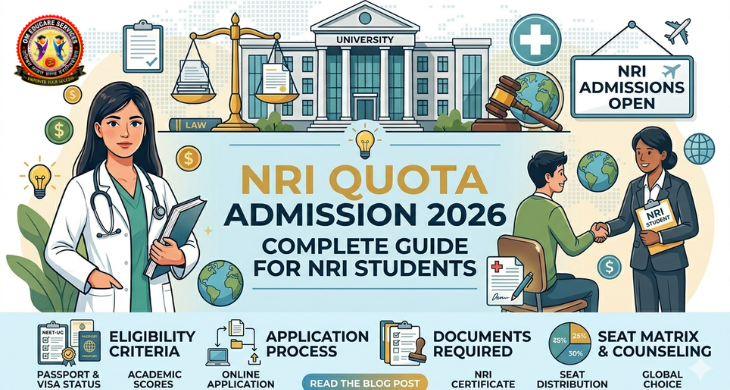
Every year, more than 20 lakh students appear for the NEET UG examination. The number of government MBBS seats, however, remains far smaller than the number of deserving aspirants. For students who qualify NEET but cannot secure a seat in regular counselling due to intense competition, the search for a reliable alternative begins immediately after results are declared.
One of the most established and legally recognised alternatives available today is MBBS Admission through NRI Quota. Offered by hundreds of private and deemed medical colleges across India, the NRI Quota reserves a dedicated percentage of seats for eligible candidates — and it comes with a comparatively lower NEET cutoff than the general category.
However, most families approach this route without accurate information. They do not know who qualifies, which relatives count as valid sponsors, what documents are needed, or how the actual counselling process unfolds. Incorrect or incomplete preparation leads to missed deadlines, rejected applications, and lost opportunities.
At Om Educare, we have guided thousands of families through this exact process. This blog gives you everything you need to know about MBBS Admission through NRI Quota in 2026 — from basic eligibility to final college reporting — explained clearly and honestly.
The NRI Quota is a specially reserved category of seats in India's private, deemed, and select government medical colleges. As per the standard seat matrix, 15% of total MBBS seats in eligible institutions are set aside for:
The key point that many families miss is this: you do not have to be an NRI yourself to apply under this quota. If your parent, sibling, grandparent, or certain other close relatives hold NRI status and are willing to officially sponsor your admission, you may be fully eligible — even as a student studying and living in India.
A valid and qualifying NEET UG score is mandatory in all cases. The NRI Quota does not bypass NEET. What it does offer is a lower effective cutoff compared to the general or management categories, making it a practical route for students who have qualified NEET but could not secure a seat through regular counselling rounds.
The fee structure under NRI Quota is, however, significantly higher than both government and management quota seats. Fees are typically charged in US Dollars and vary widely by institution — ranging from approximately USD 10,000 to USD 85,000 per year depending on the college.
Before you begin preparing documents or registering on any portal, you must confirm that you genuinely meet the eligibility requirements. Rules can vary slightly between states and individual institutions, but the following conditions apply broadly across India.
Academic and NEET Eligibility:
The student must have completed Class 10+2 with Physics, Chemistry, and Biology as core subjects. A valid NEET UG qualifying score is compulsory — the applicable minimum percentile depends on the student's category (General, OBC, SC, or ST) as per NMC norms. Without clearing NEET, no NRI Quota admission is possible under any circumstances.
Sponsorship Eligibility:
This is where the NRI Quota becomes accessible to a much wider group of Indian students. Most colleges and state counselling authorities accept sponsorship from the following close blood relatives:
The sponsor must hold valid NRI status — meaning they must be residing and working outside India — and must be willing to submit official documentation proving both their NRI status and their relationship to the student.
Important: Eligibility norms can differ between MCC counselling (for deemed universities) and individual state counselling processes. Always verify the specific requirements of the state or institution you are targeting before finalising your strategy. Om Educare's counselling team can help you confirm this based on your specific family situation.
Documentation is the most critical and most commonly mishandled part of the NRI Quota admission process. An incomplete document set can result in outright rejection at the verification stage — even if your NEET score is strong and your sponsor is genuine.
Prepare the following documents well in advance, ideally two to three months before counselling begins:
Student's Documents:
NRI Sponsor's Documents:
Relationship Proof Documents:
One important note: embassy certificates and notarised affidavits from abroad take time to obtain. Do not wait for NEET results to begin this process. If you believe NRI Quota is a likely option for your family, begin collecting these documents now.
Many families assume the NRI Quota involves a separate or informal process outside regular counselling. This is incorrect. Every NRI Quota seat must be allotted through official centralised counselling — either through the Medical Counselling Committee (MCC) for deemed universities, or through the respective State Medical Directorate for state private colleges.
Here is the complete process, step by step:
Step 1 — Qualify NEET UG 2026
Without a valid NEET UG qualifying score, no admission is possible. This is the non-negotiable first requirement. Once results are declared, check your score against the NRI Quota cutoffs of your target institutions using Om Educare's college assessment service.
Step 2 — Register on the Counselling Portal
Depending on which institutions you are targeting, register on the MCC portal (for deemed universities and central institutions) or on your chosen state's counselling portal. Registration windows open shortly after NEET results are announced. Missing the registration deadline means missing the entire round — so act quickly.
Step 3 — NRI Document Verification
This is a stage unique to NRI Quota applicants. The counselling authority — whether MCC or a state body — will verify all NRI sponsorship documents before you are permitted to participate as an NRI Quota candidate. The relationship between sponsor and student, the sponsor's NRI status, and the authenticity of embassy documents are all checked at this stage.
Submit complete, correctly attested documents. Any discrepancy or missing paperwork will result in your NRI Quota eligibility being denied.
Step 4 — Choice Filling
Once verified, you proceed to choice filling — listing your preferred colleges in order of priority. This step requires careful research. Not all colleges have the same infrastructure, clinical exposure, faculty quality, or hostel facilities. Fee structures also vary significantly from one institution to another. Take time to research each college before locking in your preferences.
Om Educare provides personalised choice-filling guidance based on your NEET score, budget, and preferred location to help you maximise your allotment outcome.
Step 5 — Seat Allotment
Seat allotment is done by the counselling software based on your NEET score, NRI Quota category, and seat availability in your preferred colleges. There is no human intervention in this process. The allotment result is published on the official portal.
Step 6 — Fee Payment and College Reporting
After receiving your allotment, you must pay the admission fee within the specified deadline and report to the allotted college with all original documents. Missing the reporting deadline results in automatic cancellation of your seat.
The fee structure for NRI Quota seats is the most significant financial commitment in this pathway. Families must plan for this well before counselling begins — not after allotment.
Tuition Fees: These are the primary cost and are typically quoted in US Dollars. Depending on the institution, annual tuition can range from USD 10,000 to USD 85,000. Deemed universities with high brand value generally sit at the higher end of this range.
Beyond Tuition — Additional Costs to Budget For:
Do not calculate your total budget based on tuition alone. A realistic total cost estimate — including all ancillary charges across five and a half years — must be worked out before you commit to this path. Om Educare's financial planning team can help you build an accurate projection based on your target institutions.
The NRI Quota is not a last resort. For many well-informed families, it is a deliberate and strategic first choice. Here is why it is gaining significance:
More Accessible Than General Category Competition: With over 20 lakh NEET applicants competing for a limited number of general category seats, even a strong score does not guarantee a government college seat. NRI Quota seats face far less competition.
Entry Into Reputed Private and Deemed Institutions: Many of India's most respected private and deemed medical colleges — with strong hospital networks, experienced faculty, and excellent infrastructure — offer NRI Quota seats. Students can secure admission in colleges that would otherwise require an extremely high NEET rank under the general category.
Structured and Transparent Process: When handled correctly, the NRI Quota counselling process is smooth, fully digital, and centralised. There are no back channels, no cash dealings, and no agents needed. Everything goes through official portals.
A Reliable Backup With a Genuine Pathway: For students who narrowly miss the cutoff for management quota seats in top colleges, NRI Quota — with its lower effective cutoff — can make a decisive difference.
Every year, families lose genuine NRI Quota opportunities due to avoidable errors. Here are the most common ones:
Starting document collection too late. Embassy certificates and notarised affidavits from abroad require weeks to process. Begin immediately after your NEET exam, not after results.
Misunderstanding the sponsorship relationship rules. Not every relative qualifies as a valid NRI sponsor. Verify your specific family relationship against the norms of your target state and institution before proceeding.
Relying on unverified agents. Fraudulent agents promise "guaranteed NRI Quota seats" for large upfront cash payments. No agent can guarantee a seat. All allotments happen through official software. Any cash demand is a scam.
Ignoring the total cost of education. Focusing only on the annual tuition figure without accounting for hostel, deposit, and miscellaneous costs leads to mid-course financial crises. Plan the full five-and-a-half-year budget.
Missing registration or reporting deadlines. Counselling timelines are strict. Missing any deadline — registration, document verification, choice filling, or college reporting — means losing your seat without exception.
At Om Educare, we understand that navigating the NRI Quota process requires both accurate information and precise execution. Our team works with families at every stage:
We believe every student who qualifies NEET deserves a fair shot at becoming a doctor. Our job is to make sure you do not lose that shot to a paperwork error or a missed deadline.
MBBS Admission through NRI Quota is a legal, structured, and increasingly important pathway for Indian students who qualify NEET but face intense competition in regular counselling. It opens doors to reputed private and deemed medical colleges with a comparatively lower cutoff — but only when approached with complete information, proper documentation, and timely action.
The process is not complicated when you understand it clearly. The eligibility criteria are defined. The documents are specific but manageable. The counselling process is centralised and transparent. What makes the difference between success and a missed opportunity is preparation — starting early, verifying every detail, and working with counsellors who know the system inside out.
If you have a qualifying NEET score and an eligible NRI sponsor in your family, this pathway deserves your serious attention in 2026.
18-Jul-2026
18-Jul-2026

18-Jul-2026
18-Jul-2026
18-Jul-2026