13-Jun-2026
Author: Om Educare

Every year, when NEET UG results are declared, millions of families across India face a difficult moment. Students who score between 150 and 500 often believe their dream of becoming a doctor is over. But here is what most parents and students do not know: a lower NEET score does not close the door to MBBS. It simply redirects the path.
One of those legal, well-established paths is the Management Quota — a system that exists in private medical colleges across India to offer merit-based seats at higher fee levels. Unfortunately, this pathway is surrounded by dangerous myths, predatory agents, and widespread misinformation that costs desperate families lakhs of rupees every admission season.
At Om Educare, we believe in giving you clear, honest, and complete information. In this guide, we will walk you through everything you need to know about Management Quota MBBS admission in 2026 — what it is, how it legally works, how it differs from the NRI Quota, which states are open to all students, what the real fees look like, and how to protect yourself from scams.
To understand Management Quota, you first need to understand how private medical colleges distribute their seats. Unlike government colleges funded by taxpayers, private colleges are built and run by trusts, societies, or private healthcare corporations. They need significant capital to operate — and the seat matrix reflects that reality.
In most private medical colleges, the seat distribution looks like this:
Government/State Quota (40–50% of seats): These seats go to state domicile students at subsidised fees, usually between ₹4 Lakhs and ₹8 Lakhs per year. The NEET cutoffs here are very high.
Management Quota (35–40% of seats): These seats are open to students who can pay the actual cost of medical education as determined and approved by the state fee fixation committee. Fees range from ₹12 Lakhs to ₹25 Lakhs per year. NEET cutoffs are correspondingly lower.
NRI Quota (15% of seats): Reserved for Non-Resident Indians, OCI, or PIO cardholders, or Indian students sponsored by a first-degree NRI blood relative. Fees are the highest, often quoted in US Dollars.
The most important fact: The Management Quota is 100% legal. It is Supreme Court-sanctioned and designed to help private institutions sustain themselves financially — provided every admission goes strictly through official counselling. There is no other legal route.
Before we go any further, let us address the misinformation head-on. These are the myths that fraudulent agents use to exploit desperate families every single year.
Myth 1: You can get MBBS admission without qualifying NEET.
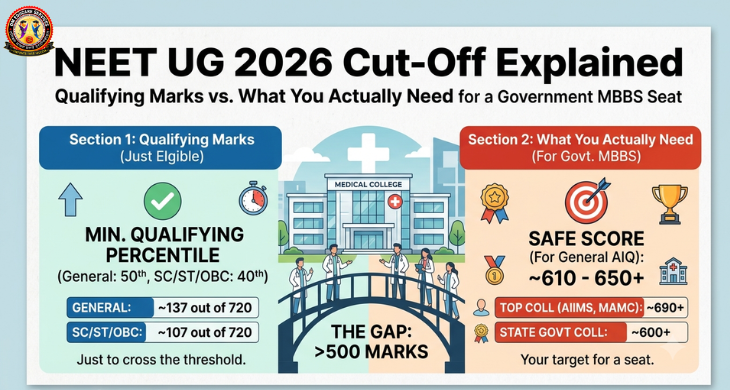
This is the most dangerous lie in Indian medical admissions. The Supreme Court and the National Medical Commission (NMC) are absolutely clear: no student can be admitted to any MBBS programme in India without clearing the NEET UG qualifying cutoff — 50th percentile for General category, 40th percentile for OBC/SC/ST. No amount of money changes this. If any agent promises you a "backdoor entry without NEET," they are committing fraud.
Myth 2: You need to pay a cash donation under the table.
This era is over. All Management Quota fees must be paid via Demand Draft or RTGS/NEFT directly to the Medical Counselling Committee (MCC), the State Directorate of Medical Education, or the allotted college's official bank account. Any demand for cash — from anyone — is illegal and is a scam. Walk away immediately.
Myth 3: College principals can reserve seats for you before counselling.
Private medical colleges have zero authority to directly admit any student at the institutional level during counselling rounds. Every seat — including Management and NRI quota seats — must be allotted through the centralised online counselling software. No exceptions.
Both options offer pathways for students with lower NEET scores, but the eligibility and financial requirements are very different. Choosing the wrong strategy wastes both time and money.
Eligibility:
Management Quota is open to any Indian citizen who has cleared the NEET qualifying cutoff. No sponsor is needed. NRI Quota requires either an NRI/OCI/PIO student or an Indian student whose first-degree blood relative — parent, sibling, grandparent, or real uncle or aunt — is an NRI and is willing to officially sponsor the admission.
NEET Score Requirement:
For Management Quota, you typically need between 300 and 550 marks depending on the college and state. For NRI Quota, even the minimum qualifying score — around 140 to 200 marks — is often sufficient.
Fee Structure:
Management Quota fees range from ₹12 Lakhs to ₹25 Lakhs per year in Indian Rupees. NRI Quota fees are significantly higher, often between $30,000 and $50,000 USD per year.
Documentation:
Management Quota requires standard NEET documents and, in some states, a bank guarantee. NRI Quota involves a complex documentation process — NRI sponsor's passport, visa copy, embassy-attested relationship affidavit, and foreign bank account statements.
If you have an NRI relative willing to sponsor your education, NRI Quota at a top-tier institution with a baseline NEET score is a highly effective strategy. But it must be planned months in advance.
When pursuing a Management Quota seat, you are choosing between two distinct categories of institutions, each with its own application process.
Deemed Medical Universities
These are autonomous, highly prestigious institutions like KMC Manipal, SRM Chennai, DY Patil Pune, and Sri Ramachandra Chennai. Admissions to all Deemed Universities are conducted centrally by the Medical Counselling Committee (MCC). There are no domicile restrictions — a student from Patna can freely apply to a Deemed University in Bengaluru. However, these are also the most expensive institutions in the country.
State Private Medical Colleges
These colleges are affiliated with their respective state health universities. Admissions are handled by State Medical Directorates — KEA in Karnataka, DMER in Maharashtra, UPDGME in Uttar Pradesh, and so on. You must register separately on each state's portal. Domicile rules vary significantly by state, and this is where your strategy must be carefully planned.
Not every state allows students from across India to participate in Management Quota counselling. This distinction — open versus closed states — is one of the most critical factors in your admission planning.
Open States to Target:
Karnataka is the most sought-after open state. It hosts legacy institutions like St. John's Medical College, MS Ramaiah, and Kempegowda Institute of Medical Sciences. Fees for other-state Management Quota seats have historically been regulated around ₹11 Lakhs per year. However, due to high demand, the NEET cutoff for Karnataka management seats is often 450 and above.
Uttar Pradesh is the most accessible destination for students scoring in the 200 to 400 range. With over 30 private medical colleges and a fully open policy, UP offers the largest volume of Management Quota seats. Fees typically range from ₹12 Lakhs to ₹16 Lakhs per year. Quality varies widely across colleges, so institutional research is essential before choice filling.
Haryana and Rajasthan also function as open states. Rajasthan management fees tend to be on the higher side, while Haryana often requires substantial bank guarantees at the time of admission.
Closed States to Note:
Maharashtra and Gujarat are strictly closed. A student from Bihar or Delhi cannot apply for a Management Quota seat in a Pune private college through state counselling. The only exception is targeting a Deemed University via MCC — which has no domicile restrictions — or applying under the NRI/Institutional Quota. If you hold Maharashtra domicile, you hold a significant advantage. Use it strategically.
There are no shortcuts in this process. Every step is monitored, digitised, and centrally managed.
Step 1 — Clear the NEET Exam
You must cross the qualifying percentile. Once results are out, immediately use Om Educare's counselling assessment service to understand which tier of private colleges your score makes you eligible for.
Step 2 — Register and Pay the Security Deposit
Register on the MCC portal for Deemed Universities or on the relevant state portals for private colleges. To participate in Management Quota counselling, you must pay a refundable security deposit. MCC Deemed counselling requires ₹2,00,000. UP State Private College counselling also requires ₹2,00,000. Karnataka (KEA) typically requires ₹1,00,000. These deposits are fully refundable if you do not accept any allotment.
Step 3 — Choice Filling and Algorithmic Allotment
You list your preferred colleges in order of priority. The centralised software matches your NEET rank against available seats and allots a college. No human being intervenes in this process.
Step 4 — Mop-Up and Stray Vacancy Rounds
After Round 1 and Round 2, remaining vacant seats enter Mop-Up and Stray Vacancy rounds. This is where the maximum number of scams have historically occurred. In earlier years, stray vacancy rounds were conducted offline at the college level, creating room for seat auctioning. This has now changed. The Supreme Court and MCC mandate that even Stray Vacancy rounds must be conducted online through the official portal. If the software does not allot you a seat, no agent can give you one. Any claim to the contrary is a fraud.
A college brochure that advertises ₹15 Lakhs per year is never showing you the complete picture. Medical colleges carry a range of additional costs that significantly raise your total expenditure.
Tuition Fee Escalation: Many colleges include a clause permitting 5–10% annual fee increases over the course of the degree.
Hostel and Mess Charges: Staying on campus is mandatory in almost all private medical colleges. This adds ₹1.5 Lakhs to ₹3 Lakhs per year to your bill.
One-Time Deposits and Material Fees: Library fees, clinical material charges, and refundable security deposits in the first year alone can add up to ₹2 Lakhs.
The Bank Guarantee: This is the single biggest financial hurdle that catches families off guard. States like Uttar Pradesh and Haryana require you to submit a bank guarantee for the remaining 3.5 years of fees at the time of admission. In practical terms, you must demonstrate to the bank that you hold assets or fixed deposits worth approximately ₹50 Lakhs to obtain this guarantee document. Without it, your allotted seat will be cancelled.
Plan for a total financial commitment of ₹80 Lakhs to ₹1 Crore for a Management Quota MBBS degree in India.
Yes, middle-class families can and do finance Management Quota MBBS admissions through education loans. Doctors have among the highest loan repayment rates in any profession, and Indian banks recognise this. Large educational loans of ₹50 Lakhs to ₹80 Lakhs are available — but they are not unsecured. You will need to pledge collateral in the form of property, land, or fixed deposits equal to the loan value.
The loan process involves understanding interest subsidy schemes, moratorium periods, and bank-specific conditions. Begin this process at least two to three months before counselling begins. Waiting until after allotment leaves you no time to arrange funds, and a missed deadline means losing your seat.
The Om Educare team can guide you through loan planning as part of your overall admission strategy.
If your family genuinely cannot arrange ₹80 Lakhs to ₹1 Crore for a Management Quota seat in India, you are not out of options. You have real, high-quality alternatives worth serious consideration.
MBBS Abroad
Several countries offer NMC-compliant MBBS programmes whose total six-year tuition costs are equivalent to — or less than — a single year at an Indian Deemed University. Russia remains the most popular destination for Indian students, backed by over 90 years of medical research tradition and government-subsidised education. Georgia is another strong option, offering European-standard education with high FMGE passage rates. Central Asian and Eastern European destinations collectively offer complete packages between ₹15 Lakhs and ₹35 Lakhs.
Important: The university you choose must strictly comply with NMC Guidelines — 54 months of course duration plus 12 months of internship, conducted entirely in English. Non-compliant universities will prevent you from obtaining a licence to practise in India.
BDS (Dental Surgery)
A highly respected clinical career with strong private practice potential. Fees are significantly lower than MBBS and the path to independent practice is well established.
AYUSH Courses — BAMS and BHMS
Ayurveda and Homeopathy are experiencing strong resurgence globally. BAMS and BHMS are full five-and-a-half-year medical degrees with their own NEET-based admission process and career pathways.
Paramedical Sciences
B.Sc Nursing, Radiology, Physiotherapy, and Medical Laboratory Technology are in high demand across both government and private healthcare. These courses offer strong employment prospects and, in many specialisations, independent practice opportunities.
At Om Educare, we have guided thousands of students and families through every layer of this process — from interpreting a NEET scorecard to finalising a college, arranging documentation, and planning finances.
We do not make promises no one can keep. We do not promise "guaranteed seats." What we offer is accurate information, strategic planning based on your specific rank and budget, real-time counselling round monitoring, and honest guidance that protects your money and your future.
Whether you are exploring Management Quota in UP or Karnataka, considering NRI Quota through a family member abroad, weighing a Deemed University against a state private college, or evaluating MBBS abroad as a genuine alternative — we will walk you through every option with full transparency.
18-Jul-2026
18-Jul-2026

18-Jul-2026
18-Jul-2026
18-Jul-2026