12-Jun-2026
Author: Om Educare
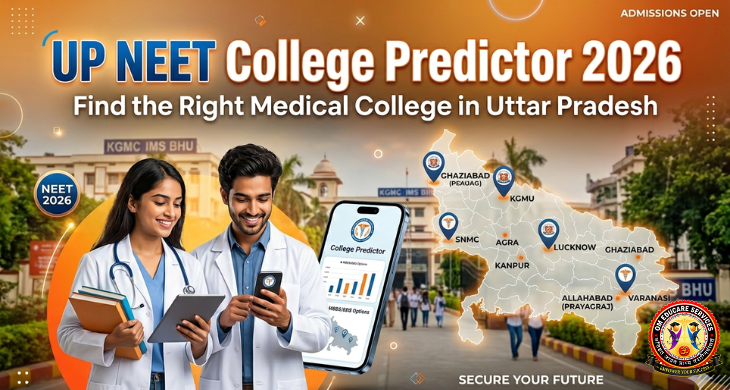
You've appeared for NEET 2026. The result is out. Now comes the question that keeps thousands of students and parents awake at night:
"Which medical college in Uttar Pradesh can I actually get into — with this score, this rank, this category?"
Uttar Pradesh is one of India's largest states for medical education, with over 70 MBBS colleges — government and private — spread across dozens of cities. Manually tracking the cutoffs of each college, across each category, across each counselling round, is not just time-consuming. It's overwhelming.
That's where a UP NEET College Predictor becomes your most important planning tool this season.
At Om Educare, we have guided thousands of NEET aspirants through UP counselling — and in this guide, we break down everything you need to know: how the predictor works, how to use it the right way, what factors affect your allotment, and the most important updates for the DGME UP 2026 counselling cycle.
A Uttar Pradesh NEET College Predictor is a data-driven tool that estimates which government and private medical colleges in UP you are likely to qualify for — based on your NEET score, All India Rank (AIR), state rank, category, and domicile.
Think of it as your personalised admission shortlist. Instead of sifting through hundreds of pages of allotment PDFs, the predictor compares your profile against historical allotment data from DGME UP (Directorate General of Medical Education, Uttar Pradesh) and gives you a probability-ranked list of colleges.
It doesn't replace counselling expertise — but it gives you a strong foundation before you walk into choice filling.
The logic behind most predictors is straightforward:
The accuracy depends entirely on how updated the database is. Always choose a predictor refreshed with the latest DGME UP allotment data — ideally 2025 or the most recent available cycle.
With 70+ medical colleges in UP, the challenge isn't knowing the options — it's narrowing them down intelligently. Here's why a predictor is worth using before choice filling:
Saves time. Get a ranked shortlist in minutes, not days.
Reduces anxiety. Knowing your realistic options early helps you plan without panic.
Sharpens strategy. You can prioritise your choice list for UP counselling based on actual probability, not guesswork.
Catches hidden opportunities. Many students miss colleges they actually qualify for. Predictors surface these.
Category-specific clarity. OBC, SC, ST, and EWS closing ranks differ significantly from the General category. A good predictor separates these clearly.
Before using a predictor, it helps to know which government colleges are most sought after:
| College | Location | Approx. MBBS Seats |
|---|---|---|
| King George's Medical University (KGMU) | Lucknow | 250 |
| BRD Medical College | Gorakhpur | 150 |
| MLB Medical College | Jhansi | 150 |
| SN Medical College | Agra | 150 |
| GSVM Medical College | Kanpur | 150 |
| LLRM Medical College | Meerut | 150 |
| RML Institute of Medical Sciences | Lucknow | 100 |
Important: KGMU consistently records the lowest closing rank in UP — making it the most competitive government college in the state. Plan your aspirational choices accordingly.
Step 1 — Keep Your Details Ready
Before opening any predictor tool, have the following on hand: NEET 2026 score and AIR, UP State Rank (if applicable), category (General / EWS / OBC / SC / ST), sub-category if any (PWD, NRI, Management Quota), and domicile status.
Step 2 — Apply Your Filters
Most predictors let you filter by college type (Government, Private, or Deemed), district or division in UP, course (MBBS or BDS), and fee range — especially useful for private colleges.
Step 3 — Analyse the Results Carefully
Once predictions appear, look beyond the college name. Check the opening rank (the best rank admitted), the closing rank (the last rank admitted — yours should be equal to or better), and round-wise data, since allotments shift significantly across Round 1, Round 2, and Mop-Up.
Step 4 — Cross-Verify with Official DGME UP Data
Always validate predictor results against the official DGME UP counselling brochure and previous year's allotment PDFs on upneet.gov.in. A predictor is a planning aid — the official data is the ground truth.
Who Conducts It?
The Directorate General of Medical Education (DGME), Uttar Pradesh conducts all state-level MBBS and BDS admissions.
Types of Seats in UP Medical Colleges
State Quota (85%) is reserved for UP domicile candidates — this is where the predictor is most relevant. All India Quota (15%) is filled by MCC and is open to all states. Management Quota is available in private colleges outside state counselling. NRI Quota is reserved for Non-Resident Indians and OCI/PIO candidates.
Reservation Breakdown — UP State Quota
| Category | Reservation |
|---|---|
| OBC | 27% |
| SC | 21% |
| EWS | 10% |
| ST | 2% |
| General (UR) | 40% |
Year-on-Year Rank Fluctuations
Cutoffs shift every year based on exam difficulty and the total number of candidates. Build a 5–10% margin of error into all your planning.
Seat Matrix Updates
New government medical colleges have been operationalised in UP — including in Mirzapur, Azamgarh, Pratapgarh, and Deoria. These newer colleges have higher closing ranks (easier cutoffs), creating real opportunities for mid-rank students.
Category-Specific Cutoffs
The closing rank for OBC can be 2x to 3x higher than the General category closing rank at the same college. Never check only the overall cutoff — always look at your specific category data.
Round-Wise Variation
Closing ranks ease as rounds progress. Top-rankers who secured seats in Round 1 exit the pool, creating new openings in Round 2 and the Mop-Up round. If you missed Round 1, the race is not over.
Treating predictions as guarantees. A predictor gives probabilities, not certainties. Actual allotment depends on how many students ranked above you choose that college in their preference list.
Ignoring category-specific cutoffs. OBC, SC, ST, and EWS closing ranks are very different numbers from the general merit list. Always check category-wise data separately.
Using outdated tools. A predictor running on 2021 data for 2026 counselling can mislead you seriously. Always verify the tool's database year before trusting its results.
Filling too few choices. Many students fill only 5–6 colleges based on predictor output. This is a critical strategic error. Aim for 15–20+ choices during DGME UP choice filling — spread across high-probability, moderate, and aspirational options.
Overlooking private colleges. Era's Lucknow Medical College, Rama Medical College, and Santosh Medical College are among the private institutions in UP that are within reach for a large segment of NEET 2026 aspirants. Run the predictor for private colleges too, with a fee filter applied.
Skipping Mop-Up and Stray Vacancy rounds. Thousands of seats go unfilled after Round 1 and Round 2. Re-run the predictor with updated data before each round — these rounds can be a genuine second chance.
New government colleges added. UP has added several new government medical colleges in recent years. More seats mean more opportunities, especially for ranks in the 15,000–40,000 range.
EWS reservation fully active. The 10% EWS quota is implemented across all UP government medical colleges. EWS candidates should use category-specific prediction filters.
Stricter domicile verification. DGME UP has tightened scrutiny on UP domicile certificates. Ensure yours is valid and current before registration begins.
Fully digital counselling. Registration, choice filling, document verification, and seat allotment are all online — which means shorter decision windows. Stay alert during each allotment phase.
Rural service bond. Students allotted government MBBS seats in UP must complete a rural service bond after graduation. Understand this commitment before locking your preference.
This is one of the most common points of confusion — and it matters.
UP counselling is rank-based, not score-based. Your All India Rank (AIR) determines your national standing. But for state quota seats, your UP State Rank is what DGME uses in the merit list.
A UP domicile candidate with AIR 15,000 might hold a UP State Rank of 5,000 — because state-level competition is much smaller than the national pool. This means UP domicile students often have a significant advantage in state quota seats compared to what their AIR alone suggests.
If a predictor tool is only using AIR, its state quota predictions will be off. Always choose a tool that factors in state rank.
A college predictor tells you where you might get in. Expert counselling tells you where you should apply — and exactly how to get there.
At Om Educare, we combine data-backed analysis with years of UP counselling experience to help NEET aspirants build the right choice list for DGME UP counselling, understand category-specific cutoff trends, navigate mop-up and stray vacancy rounds, and make final decisions with full confidence.
Whether you're targeting KGMU, a new government college, or a private institution within your budget — we're here at every step.
18-Jul-2026
18-Jul-2026
18-Jul-2026
18-Jul-2026
18-Jul-2026