04-Jun-2026
Author: Om Educare
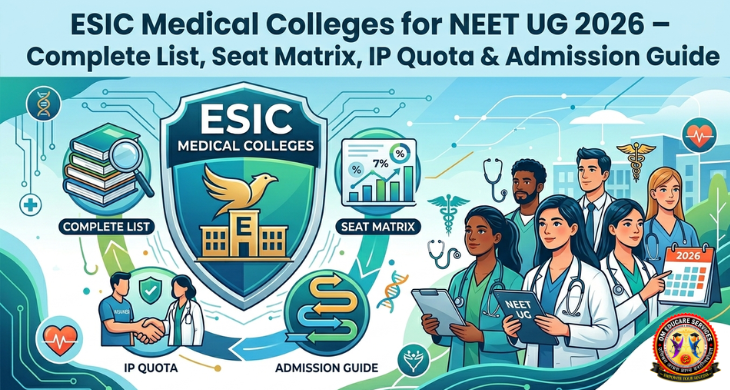
Every year, lakhs of NEET UG aspirants across India search for affordable, quality medical colleges where their hard work can translate into a genuine MBBS seat without an unbearable financial burden. If you or your family are covered under the Employees' State Insurance (ESI) scheme, then ESIC medical colleges may be one of the most valuable — and underutilised — opportunities available to you.
At Om Educare, we believe every student deserves complete and accurate information before making one of the most important decisions of their life. This guide covers everything you need to know about ESIC medical colleges participating in NEET UG 2026 — from the complete college list and seat matrix to the IP quota advantage and step-by-step admission process.
ESIC medical colleges are institutions established and operated by the Employees' State Insurance Corporation, a statutory body functioning under the Ministry of Labour and Employment, Government of India. These colleges were created under the ESI Act of 1948 with a core mission of providing accessible, affordable, and quality healthcare education — particularly for the benefit of the working-class families enrolled under the ESI scheme.
What sets ESIC medical colleges apart from most other government and private medical institutions is their unique dual-quota admission structure, their relatively lower fee schedules, and the direct advantage they offer to children of ESI-insured employees through the Insured Person (IP) quota.
Today, ESIC operates a network of 20 medical colleges spread across India, collectively offering 1,830 MBBS seats for NEET UG 2026 — a number that has grown significantly over the past few years with several new colleges beginning admissions.
Before diving into the complete list, it is worth understanding exactly what distinguishes ESIC colleges from regular state government medical colleges.
Dual Quota System: Seats in ESIC colleges are divided into the All India Quota (AIQ) and the Insured Person (IP) Quota. Roughly 15% of seats fall under AIQ and are open to all NEET-qualified candidates through MCC counselling. The remaining approximately 85% of seats are reserved exclusively for wards of ESI-insured employees — giving ESI families a dramatically improved chance of admission.
Affordable Fee Structure: ESIC colleges are known for charging significantly lower tuition fees compared to private medical colleges and even many self-financing government institutions. For families from working and middle-class backgrounds, this difference can be life-changing.
Centralised Admission Through MCC: All admissions to ESIC colleges are managed through the Medical Counselling Committee (MCC) based on NEET UG ranks and category — ensuring a transparent, standardised, and merit-based process.
Modern Infrastructure: Most ESIC colleges are relatively new institutions, many established between 2012 and 2025, with modern laboratories, updated classroom facilities, and attached hospitals that offer solid clinical training.
Special Opportunity for ESI Families: The IP quota gives children of ESI-insured employees a genuine edge. In real outcomes, many students from ESI-insured families have secured MBBS seats with NEET scores that would not have been competitive enough for open category seats in top government colleges.
The following is the complete list of all 20 ESIC medical colleges participating in NEET UG 2026 admissions, along with their state, year of establishment, and available MBBS seats:
1. ESIC Medical College, Beltola, Guwahati — Assam Established: 2025 | MBBS Seats: 50
2. ESIC Medical College and Hospital, Bihta, Patna — Bihar Established: 2021 | MBBS Seats: 100
3. ESIC Medical College, Basaidarapur — New Delhi Established: 2025 | MBBS Seats: 50
4. ESIC Medical College, Naroda, Ahmedabad — Gujarat Established: 2025 | MBBS Seats: 50
5. ESIC Medical College and Hospital, Faridabad — Haryana Established: 2015 | MBBS Seats: 150
6. Shri Lal Bahadur Shastri Medical College, Mandi — Himachal Pradesh Established: 2017 | MBBS Seats: 120
7. ESIC Medical College, PGIMSR and Model Hospital, Rajaji Nagar, Bangalore — Karnataka Established: 2012 | MBBS Seats: 150
8. ESIC Medical College, Gulbarga — Karnataka Established: 2013 | MBBS Seats: 150
9. Government Medical College, Paripally, Kollam — Kerala Established: 2017 | MBBS Seats: 110
10. ESIC Medical College and Hospital, Indore — Madhya Pradesh Established: 2025 | MBBS Seats: 50
11. ESIC Medical College and Hospital, Andheri (E) — Maharashtra Established: 2025 | MBBS Seats: 50
12. ESIC Medical College, Ludhiana — Punjab Established: 2025 | MBBS Seats: 50
13. ESIC Medical College, Alwar — Rajasthan Established: 2021 | MBBS Seats: 100
14. ESIC Medical College, Jaipur — Rajasthan Established: 2025 | MBBS Seats: 50
15. ESIC Medical College and PGIMSR, K.K. Nagar, Chennai — Tamil Nadu Established: 2013 | MBBS Seats: 150
16. ESIC Medical College, Coimbatore — Tamil Nadu Established: 2016 | MBBS Seats: 100
17. ESIC Medical College and Hospital, Sanathnagar, Hyderabad — Telangana Established: 2016 | MBBS Seats: 100
18. ESIC Medical College, Noida — Uttar Pradesh Established: 2025 | MBBS Seats: 50
19. ESIC Medical College, Varanasi — Uttar Pradesh Established: 2025 | MBBS Seats: 50
20. ESI-PGIMSR, Medical College and Hospital, Joka, Kolkata — West Bengal Established: 2013 | MBBS Seats: 150
Total MBBS Seats Available in ESIC Colleges for NEET UG 2026: 1,830
This network spans nearly every major region of India — north, south, east, west, and central — giving students and families a wide range of options based on location, preference, and quota eligibility.
Understanding how seats are distributed in ESIC colleges is critical to planning your counselling strategy correctly.
All India Quota (AIQ) covers approximately 15% of total seats in each ESIC college. These seats are open to any NEET UG qualified candidate from anywhere in India and are filled through MCC counselling based purely on NEET merit and category.
Insured Person (IP) Quota covers approximately 85% of seats and is reserved exclusively for wards and dependents of individuals insured under the ESI scheme. This is the defining feature of ESIC colleges and the primary reason why ESI-insured families should prioritise these institutions during counselling.
Om Educare Note: Always verify the exact seat matrix for your target college directly from the official MCC portal before choice-filling. Quota percentages can vary slightly by state, college, and year. The seat matrix is published fresh every year ahead of counselling registration.
Many students wonder whether ESIC colleges are comparable to regular state government medical colleges in terms of quality and value. Here is a clear comparison:
ESIC colleges offer a special IP quota for ESI wards, which regular government colleges do not. Fees are generally lower in ESIC colleges compared to many government institutions, particularly self-financing government colleges. Admissions to ESIC colleges are handled centrally by MCC based on NEET UG rank, while most regular government college seats are filled through state-level counselling. ESIC colleges collectively offer 1,830 MBBS seats for 2026, while the total pool of government seats across India is much larger overall. Special quota eligibility in ESIC colleges depends on ESI insured status, while eligibility for special quotas in state government colleges typically depends on domicile and category.
The key takeaway is that for ESI-insured families, ESIC colleges offer a combination of affordability, quality, and genuine quota advantage that is difficult to find anywhere else in the Indian medical admission ecosystem.
To be considered for admission under the IP quota in ESIC colleges, the following conditions must be met:
The candidate must be a dependent — typically a child or ward — of a person currently insured under the ESI scheme. The insured person's ESI contributions must be active and up to date, with a minimum contribution period of at least 6 months before NEET UG registration. An eligibility certificate issued by the ESIC authorities must be produced during the counselling and document verification process.
If you fall under the IP quota category, do not underestimate this advantage. The competition within the IP quota is significantly lower compared to the open AIQ category, meaning students with moderate NEET scores can still secure a seat in an ESIC college through this pathway.
Om Educare Tip: Obtain your IP quota eligibility certificate from the ESIC authorities well in advance — ideally before NEET results are declared. Processing this certificate takes time, and delays can cost you your seat during counselling.
Step 1 — Appear for NEET UG 2026
Only candidates who have qualified NEET UG 2026 are eligible for ESIC college admissions. NEET UG 2026 is scheduled for May 3, 2026. Register with the National Testing Agency (NTA) at ntaneet.nic.in well before the deadline.
Step 2 — Check NEET Results and Eligibility
Once NEET results are declared — typically in June — verify your qualifying percentile and check whether you meet the minimum cutoff for your category. Cross-reference your score with ESIC college-wise previous year cutoffs to identify realistic target colleges.
Step 3 — Register on the MCC Portal
Visit mcc.nic.in and complete your registration for NEET UG counselling. During registration, indicate whether you are applying under the IP quota. Pay the registration fee and upload all required documents within the specified window.
Step 4 — Gather and Submit All Documents
Along with standard documents such as your NEET scorecard, identity proof, Class 10 and 12 mark sheets, and category certificate if applicable — IP quota applicants must submit their ESI eligibility certificate issued by ESIC authorities. Ensure all documents are in order before the verification stage.
Step 5 — Choice Filling and Locking
During the choice-filling window, shortlist and rank all ESIC colleges you wish to apply to. Research each college's location, infrastructure, hospital size, and past cutoffs before finalising your preference list. Lock your choices before the deadline — changes cannot be made after locking.
Step 6 — Seat Allotment
MCC will allot seats based on NEET rank, category, quota eligibility, and preference order. Allotment results are published on the official MCC portal. Higher NEET scores within each quota are given priority.
Step 7 — Accept Seat and Report to College
If a seat is allotted, log in to the MCC portal, accept the allotment, and pay the required fee within the deadline. Then report to the allotted ESIC college with all original documents to complete the enrollment process and formally secure your MBBS seat.
Critical Reminder from Om Educare: MCC counselling deadlines are strict. Missing even a single deadline — whether for registration, choice-filling, fee payment, or reporting — can result in losing your allotted seat and potentially missing the entire round. Mark every date on your calendar and act well in advance.
Lower Fees Than Private Colleges: The tuition and total course fees in ESIC colleges are a fraction of what private medical colleges charge — making a quality MBBS degree genuinely accessible to working and middle-class families.
Modern, Well-Equipped Facilities: Since most ESIC colleges were established between 2012 and 2025, their infrastructure is relatively new and well-maintained — with updated labs, simulation facilities, and attached hospitals providing real clinical exposure.
Pan-India Presence: With colleges in 20 states from Assam to Kerala and Rajasthan to West Bengal, students can often find an ESIC college in or near their home state — reducing relocation challenges and costs.
IP Quota Is a Genuine Competitive Advantage: For the approximately 13 crore people currently enrolled under the ESI scheme in India, the IP quota in ESIC colleges is one of the most under-utilised benefits available. Many eligible families are simply unaware of this opportunity or do not plan for it in time.
Centralised and Transparent Admissions: Because all admissions are handled through MCC based on NEET UG merit, the process is standardised, transparent, and free from state-level complications or domicile restrictions for AIQ seats.
Q. Can a student who is not from an ESI-insured family apply to ESIC colleges? Yes. Approximately 15% of seats fall under the All India Quota (AIQ) and are open to all NEET-qualified candidates regardless of ESI enrollment.
Q. Is a separate exam required for ESIC college admission? No. NEET UG is the only entrance exam required. There is no separate ESIC entrance test.
Q. How do I obtain the IP quota eligibility certificate? The eligibility certificate is issued by your nearest ESIC branch or regional office upon application by the insured employee (your parent or guardian). Start this process early as it can take several weeks.
Q. Are ESIC colleges recognised by the NMC? Yes. All ESIC medical colleges are recognised by the National Medical Commission (NMC) and offer a valid, government-recognised MBBS degree.
Q. What is the NEET score required for ESIC college admission? The required score varies by college, category, and quota. IP quota cutoffs are generally lower than AIQ cutoffs. Refer to previous year cutoff data on the MCC portal for reference.
For NEET UG 2026 aspirants — especially those from ESI-insured families — ESIC medical colleges represent one of the most valuable and accessible pathways to an MBBS seat in India. With 1,830 seats across 20 colleges, a powerful IP quota advantage for eligible students, affordable fees, and centralised MCC-based admissions, these institutions deserve a prominent place on every eligible student's preference list.
The difference between securing a seat and missing out often comes down to two things — preparation and timely documentation. Start your ESIC eligibility certificate process early, register on the MCC portal without delay, and approach counselling with a well-researched preference list.
At Om Educare, we are committed to helping every NEET aspirant navigate the counselling process with clarity and confidence — whether you are appearing for the first time or attempting again.
Your MBBS seat is within reach. Plan smart, act early, and make every opportunity count
18-Jul-2026
18-Jul-2026
18-Jul-2026
18-Jul-2026
18-Jul-2026