02-Jun-2026
Author: Om Educare
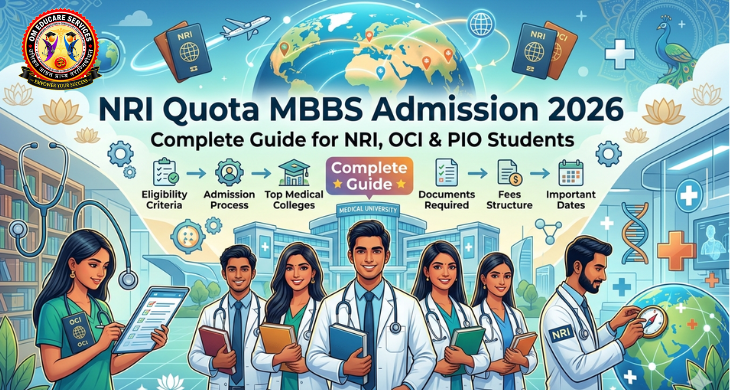
Every year, thousands of Indian families settled abroad dream of securing an MBBS seat for their child in India. Whether you are based in the UAE, USA, UK, Canada, Australia, or anywhere across the globe — if an MBBS seat in a recognised Indian medical college is your goal, the NRI quota is the pathway designed specifically for you.
At Om Educare, we have guided hundreds of NRI families through every stage of this process - from understanding eligibility to walking into the allotted college on the first day. This comprehensive guide covers everything you need to know about MBBS admission under NRI quota in 2026.
The NRI quota - short for Non-Resident Indian quota - is a government-mandated reserved category of seats in Indian medical colleges. As per the guidelines of the National Medical Commission (NMC), approximately 15% of total MBBS seats in eligible government and private medical colleges are reserved under this category for NRI, OCI, and PIO candidates.
To put it simply: for every 100 MBBS seats in a medical college, around 15 are set aside exclusively for NRI category students. These students do not compete against the 85% of resident Indian students in the general merit pool. This makes the NRI quota an accessible and valuable pathway - especially for students who have strong academic credentials but find it difficult to compete in India's highly competitive general NEET merit list.
One important point to keep in mind: NRI quota seats are filled through a separate counselling process and come with higher fee structures compared to regular seats. The trade-off is significantly reduced competition and a more manageable admission pathway.
The definition of NRI in the context of MBBS admissions is broader than its everyday usage. As per MCC and state counselling guidelines, the following individuals are eligible:
Indian citizens residing or working abroad for employment, business, or other purposes qualify. Children of Indian citizens settled abroad also qualify. Overseas Citizens of India (OCI) cardholders are eligible, as are Persons of Indian Origin (PIO) holding a PIO card or OCI card. Children of State or Central Government employees posted abroad on official deputation are included as well.
Most importantly, students whose close blood relatives — such as a parent, grandparent, sibling, or uncle/aunt — are NRIs may also qualify for the NRI quota even if the student themselves is currently based in India. This NRI-sponsored category is one of the most commonly misunderstood aspects of the process.
The eligibility rules on NRI sponsorship vary slightly by state and institution, so always verify with the specific college or counselling authority before applying.
Before collecting documents or registering for counselling, every student must confirm they meet the following criteria:
Academic Eligibility
Candidates must have completed Class 10+2 or an equivalent examination from a recognised board, with Physics, Chemistry, Biology/Biotechnology, and English as compulsory subjects. A minimum aggregate of 50% marks in PCB is required for General category students, and 40% for SC/ST/OBC candidates. Students currently appearing in Class 12 examinations may apply provisionally.
Age Criteria
The minimum age is 17 years as on December 31 of the admission year. The maximum age is 25 years, or 30 years for reserved category candidates as per Supreme Court rulings.
NEET-UG Eligibility
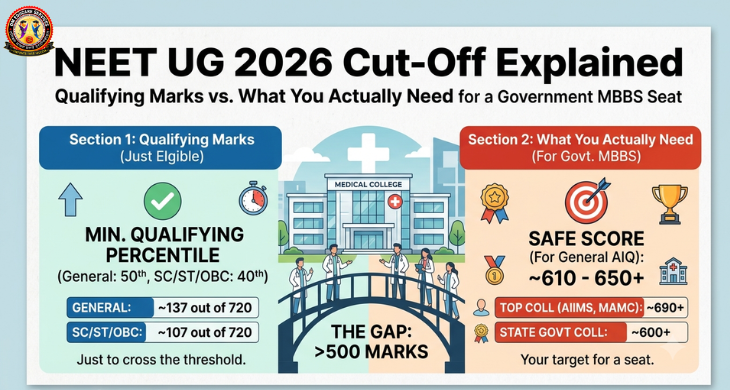
Qualifying NEET-UG is mandatory for all NRI quota applicants without any exemption. The minimum qualifying percentile is the 50th percentile for General category and the 40th percentile for SC/ST/OBC candidates. NRI students can appear for NEET-UG at examination centres within India as well as at international centres in the UAE, Qatar, Kuwait, Saudi Arabia, Bahrain, Oman, Malaysia, Singapore, Thailand, Nigeria, Nepal, and Sri Lanka.
NRI/OCI/PIO Status
The candidate, or at least one parent or close blood relative, must hold valid NRI, OCI, or PIO status. A valid passport with foreign country residence visa stamps, or an OCI/PIO card, is required as proof. For NRI-sponsored candidates, the sponsor's proof of relationship must be clearly and formally documented.
Om Educare Tip: Even if your NEET score falls in the 300 to 400 range, you may still secure a good NRI quota seat because the competition pool is significantly smaller than the general merit list. Focus equally on getting your documents in order — that is where most applications go wrong.
Documentation is the backbone of every NRI quota application. Missing or incorrectly attested documents can disqualify a candidate from the counselling process entirely. Here is a comprehensive checklist:
Candidate's Documents
NEET-UG admit card and scorecard, Class 10 and Class 12 mark sheets and passing certificates, birth certificate in English, candidate's valid Indian passport, recent passport-size photographs, Transfer Certificate and Migration Certificate, and domicile/residence certificate where required by the state.
NRI/OCI/PIO Status Documents
NRI status certificate from the Indian Diplomatic Mission (embassy or consulate) of the country of residence, valid passport of the NRI candidate or sponsor with visa and residency permit pages, OCI card for OCI cardholders, PIO card where applicable, and employment proof of the NRI sponsor such as offer letter, work permit, or salary slips.
For NRI-Sponsored Candidates
Proof of blood relationship between the candidate and NRI sponsor (birth certificates or a family tree affidavit), NRI sponsorship certificate specifying the NRI status, exact relationship with the candidate, and willingness to bear the full course fee, sponsor's valid foreign passport with valid visa or residency stamp, sponsor's employment or business proof in the foreign country, and a notarised affidavit from the sponsor.
Financial Documents
Proof of financial capability such as bank statements and income proof may be required by some colleges. Fee payment receipts and bank guarantee letters may also be required by specific institutions.
Critical Note: All documents issued in a foreign language must be officially translated into English and attested by the Indian Embassy or Consulate in that country. Start this process early - it can take 4 to 6 weeks minimum.
Step 1 – Appear for NEET-UG
NEET-UG is the mandatory gateway exam for all MBBS admissions in India, including under the NRI quota. Register with the National Testing Agency (NTA) at ntaneet.nic.in and choose an exam centre in India or at one of the international centres. NEET-UG 2026 is scheduled for May 3, 2026.
Step 2 – Await NEET Results and Check Eligibility
Once NEET results are declared — typically in June — verify whether you have cleared the minimum qualifying percentile for NRI quota. Cross-check college-wise and state-wise cutoffs to shortlist your target colleges.
Step 3 – Begin Document Collection and Attestation
Start gathering all required documents simultaneously with your NEET preparation. Do not wait for results to begin this process. NRI-related documents, especially the status certificate from the Indian Embassy, can take 4 to 8 weeks. Late documentation is one of the most common causes of missed admissions.
Step 4 – Register for MCC Counselling
The Medical Counselling Committee (MCC) conducts counselling for NRI quota seats in deemed and central universities as well as JIPMER. Register at mcc.nic.in during the registration window, pay the registration fee, upload all required documents, and select the NRI category during registration.
Step 5 – Register for State Counselling
For NRI quota seats in state government and private colleges, register with the respective state counselling authority. Each state has its own website, fee structure, and timeline. Always register for both MCC and relevant state counselling simultaneously to maximise your options.
Step 6 – Fill College and Course Preferences
During the choice-filling window, list all colleges in your preferred order. Research each college's infrastructure, clinical exposure, faculty quality, and location before finalising your list. Careful preference filling directly impacts your seat allotment outcome.
Step 7 – Document Verification
All original documents are physically verified at designated counselling centres or at the college itself. Carry both originals and multiple attested photocopies. Any discrepancy at this stage can lead to immediate cancellation of the allotment.
Step 8 – Seat Allotment
Seats are allotted based on NEET score, category, NRI quota availability, and preference order. Higher NEET scores are given priority. Allotment results are published on the official counselling portal.
Step 9 – Accept Seat and Pay Fee
Log in to the portal, accept the allotted seat, and pay the required fee — in USD or INR equivalent as specified by the institution. Some colleges require a demand draft or international wire transfer in USD.
Step 10 – Report to College
Report to the allotted college within the specified deadline with all original documents and complete the institutional enrollment process to formally secure your MBBS seat.
Fees under the NRI quota are significantly higher than for general category students in India, but considerably lower than pursuing MBBS in the USA, UK, or Australia. The table below provides a comparative overview:
Government college NRI quota: approximately USD 15,000 to 40,000 per year, totalling approximately USD 80,000 to 1,20,000 for the full 5.5-year course, payable in USD or INR equivalent.
Private college NRI quota: approximately USD 20,000 to 75,000 per year, totalling approximately USD 1,10,000 to 1,50,000, payable in USD.
Deemed university NRI quota: approximately USD 25,000 to 60,000 per year, totalling approximately USD 1,00,000 to 1,40,000, payable in USD.
For context, MBBS in the USA or UK typically costs over USD 50,000 per year, with total costs exceeding USD 2,50,000 — making India's NRI quota a highly cost-effective alternative for families of Indian origin.
State-wise fee highlights for 2026:
Karnataka private colleges charge approximately USD 20,000 to 30,000 per year. Maharashtra government and private colleges charge approximately USD 15,000 to 45,000 per year. Andhra Pradesh and Telangana private colleges charge approximately USD 20,000 to 35,000 per year. Kerala private colleges charge approximately USD 15,000 to 30,000 per year. Rajasthan government colleges offer relatively lower fees at approximately USD 15,000 to 25,000 per year. Punjab and Haryana government medical colleges charge approximately USD 12,000 to 25,000 per year. Tamil Nadu private and deemed colleges charge approximately USD 20,000 to 40,000 per year.
Fees quoted above are approximate and change annually. Always verify the exact fee structure from the official college prospectus or state counselling authority at the time of admission.
One of the most critical things to understand about NRI MBBS admission is that rules are not uniform across states. Each state sets its own policies for eligibility, fee regulation, and seat allocation.
States with NRI quota in government medical colleges include Rajasthan (RUHS), Haryana (DGHS), Punjab (BFUHS), Himachal Pradesh (HP DMET), Puducherry and JIPMER (MCC), Goa (DMER), Jammu and Kashmir (J&K BOSE), and Chandigarh. Each of these reserves approximately 15% of total seats for NRI category students.
States with NRI quota only in private or deemed colleges include Karnataka with approximately 850 NRI quota seats counselled by KEA, Maharashtra with both government and private NRI seats regulated by the state FRC, Andhra Pradesh and Telangana with approximately 600 combined NRI seats in private colleges, Tamil Nadu with private and deemed university seats counselled by TNMC, Kerala with approximately 250 NRI seats in private colleges counselled by CEE, and West Bengal with limited private college seats.
Some states require additional local domicile proof or a state-specific NRI certificate. Seat matrices are announced fresh every year and can change. A few states have also introduced merit-based selection within the NRI quota category itself, so a higher NEET score continues to matter.
MCC Counselling (Deemed Universities and Central Institutions)
Conducted by the Medical Counselling Committee at mcc.nic.in, this covers NRI quota seats in all deemed and central universities and JIPMER Puducherry. It typically consists of three rounds -Round 1, Round 2, and a Mop-Up Round — with online choice-filling, seat allotment, and document verification at reporting centres.
State-Level Counselling
Each state has a designated authority and portal. Registration typically opens after MCC Round 1 results are declared. Some states allow online document verification while others require physical presence. Vacant NRI seats after Round 2 are usually offered in mop-up or stray vacancy rounds.
Typical Counselling Timeline:
NEET-UG examination takes place in May. Results are declared in June. MCC AIQ counselling registration opens in July and August. MCC Round 1 and Round 2 seat allotment including NRI category happens in August and September. State-level NRI quota counselling registration and seat allotment occurs from September to November. Mop-up and stray vacancy rounds take place from November to December.
Key Benefits
The NRI quota offers lower competition than the general merit list due to a significantly smaller candidate pool. It provides access to globally recognised MBBS degrees from NMC-approved colleges. Total costs ranging from USD 80,000 to 1,50,000 are substantially lower than MBBS in Western countries. Indian teaching hospitals offer rich clinical training with high patient volumes. The pathway is structured through government-regulated counselling with a high degree of transparency.
Common Challenges
Complex documentation with frequent attestation delays for overseas documents remains the biggest challenge. Higher fee burden compared to general category students is significant. State-specific rules create confusion for families unfamiliar with Indian education policies. Tight counselling timelines mean that missing a single deadline can result in waiting another full year. Post-admission licensing now requires clearing NExT (National Exit Test) to practise medicine in India.
Starting document collection after NEET results are declared is one of the costliest mistakes. Begin the process at least 6 months before the examination. Embassy attestations take significant time.
Not verifying whether the college or state recognises the sponsor's relationship category leads to rejection. Different states have different rules on who qualifies as a valid NRI sponsor.
Applying only to one counselling route — either MCC or state — is a major error. Always register for both MCC and all relevant state counselling portals simultaneously.
Submitting untranslated or unofficially translated documents causes immediate disqualification. All foreign language documents must carry official, attested English translations.
Ignoring college accreditation status is a risk many families overlook. Always verify NMC approval, hospital bed strength, and annual batch size of each target institution.
Missing counselling registration deadlines is surprisingly common. Most portals remain open for only 7 to 10 days. Missing the window means losing the entire round.
Paying fees to unregistered consultants without verifying their credentials is a serious financial risk. Always verify the registration and track record of any admission consultant you engage.
Total MBBS seats in India have grown to approximately 1,17,975 across 779 medical colleges, creating more NRI quota opportunities than ever before.
The NExT (National Exit Test) now applies to all MBBS graduates from 2023-24 onwards. NRI quota students are equally subject to this licensing requirement to practise medicine in India.
NEET-UG 2026 is scheduled for May 3, 2026. NRI students applying for 2026 admissions must register and appear for this examination.
MCC has streamlined online NRI document verification, reducing the need for physical reporting in some states.
Several states are tightening documentation norms especially around NRI sponsorship certificates to reduce misuse of the quota.
International NEET centres have expanded further, making it easier for NRI students in the Middle East and Southeast Asia to appear locally without travelling to India.
The NRI quota MBBS admission process is detailed, document-intensive, and time-sensitive — but for the well-prepared student and family, it represents an excellent pathway to a quality medical education at a fraction of the cost of Western alternatives.
At Om Educare, we have walked hundreds of NRI families through every step of this journey — from the first document check to the final college reporting. We understand the nuances of state-wise rules, MCC timelines, embassy documentation, and college-specific requirements.
If you are planning MBBS admission under NRI quota for 2026, do not leave it to chance. Start early, get your documents right, and register with expert guidance.
Your child's MBBS dream in India is achievable — let Om Educare show you the way.
Published by Om Educare | Expert NRI Quota MBBS Admission Guidance for Families Across India and Abroad
For personalised counselling and document support, contact Om Educare today
18-Jul-2026
18-Jul-2026

18-Jul-2026
18-Jul-2026
18-Jul-2026