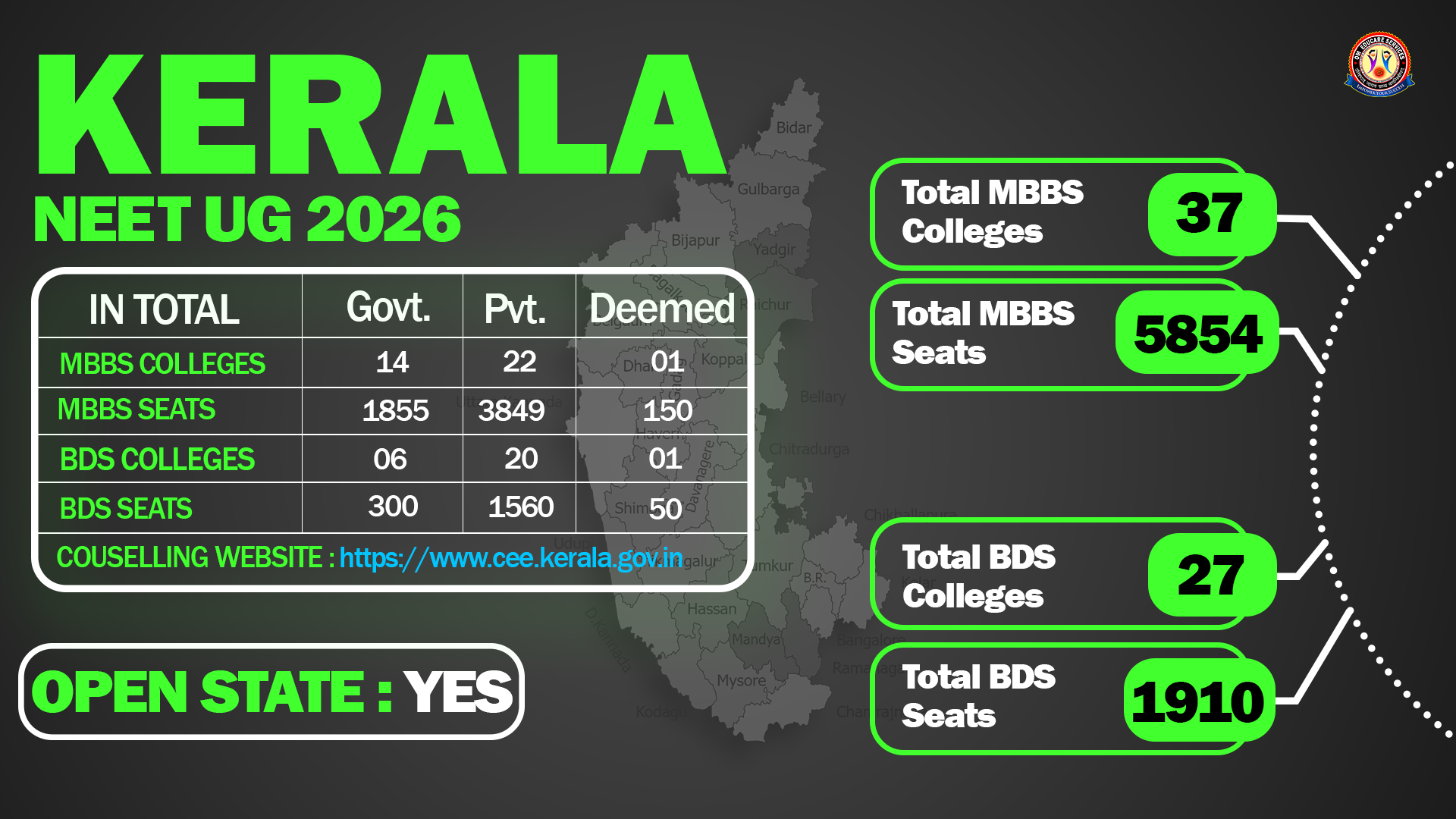
The Commissioner for Entrance Examinations (CEE) is responsible for the allotment process in Kerala. Admission to MBBS and BDS courses is based solely on the NEET-UG rank. The process involves a Single Window System (SWS) of Centralised Allotment Process (CAP) conducted through the official website. This process is highly regulated by the State Government and various national councils (NMC/DCI) to ensure merit-based and transparent admissions
Candidates are classified into three categories based on their residency and origin:
Keralite: Candidates of Kerala origin are eligible for the full range of communal and special reservations. Children of All India Service (AIS) officers (Non-Keralites) allotted to the Kerala cadre are also deemed Keralites, though they cannot claim communal reservations.
Non-Keralite Category I (NK I): This includes candidates who are not of Kerala origin but fulfill specific residency or service criteria, such as:
Candidates who have undergone a course of study in Kerala for at least five years within a twelve-year period.
Candidates who have studied in Kerala for classes 11 and 12, provided their parent is a Government of India/AIS officer stationed in Kerala.
Note: NK I candidates are eligible for Allotment to Government and Private Self-Financing colleges but cannot claim communal or PwD reservations.
Non-Keralite Category II (NK II): Candidates who do not fall under the above categories. They are generally eligible only for "Open Merit" seats in Private Self-Financing colleges and for institutional preference seats in specific regional institutes.
The seats in Government colleges and the Government seats in Self-Financing colleges are distributed as follows:
State Merit (SM): 50% of seats are allotted based on pure merit.
Socially and Educationally Backward Classes (SEBC): 30% of seats are reserved for these categories, including Ezhava, Muslim, Other Hindus, Latin Catholics, and others.
Scheduled Castes & Scheduled Tribes: 10% of seats (8% for SC, 2% for ST).
Economically Weaker Sections (EWS): 10% of seats are reserved for EWS candidates who are not covered under communal reservations.
Persons with Disabilities (PwD): 5% of the total seats are reserved for candidates with benchmark disabilities.
Candidates must upload digital copies of the following documents during the application and verification process:
Nativity Proof: SSLC/Birth Certificate/Passport/Nativity Certificate to prove Keralite or Non-Keralite status.
Academic Proof: Admit Card of the Entrance Examination and the Mark list/Pass Certificate of the qualifying examination (Class 12).
Community/Caste Certificates: For those claiming SEBC, SC, or ST reservations, issued by the competent Revenue Authority.
Income Certificate: Required for SEBC and EWS candidates to prove eligibility for reservation or fee concessions.
Medical Certificate: For candidates claiming PwD reservation, issued by a State Medical Board.
The application process is entirely online:
Registration: Create a profile on the CEE website (www.cee.kerala.gov.in) using a valid mobile number and email.
Fill Application: Enter personal, academic, and reservation details.
Pay Application Fee: The fee can be paid online or via e-challan at post offices.
Upload Images and Documents: Upload a photograph, signature, and all required supporting documents in the specified format.
Print Confirmation: Download and keep the "Data Sheet" for future reference.
Notification: The CEE publishes the schedule for option entry.
Option Entry: Candidates log in to the portal and enter their preferences for colleges and courses. There is no limit to the number of options that can be registered.
Trial Allotment: A trial run is conducted to give candidates an idea of the seats they might get.
Allotment: Seats are allotted based on merit and the order of options registered.
Fee Payment & Joining: Candidates who receive an allotment must pay the required tuition fee to the CEE and report to the allotted college for final admission.
Subsequent Rounds: Vacant seats are filled through second, third (mop-up), and stray vacancy rounds.