26-Jul-2026
Author: OM EDUCARE
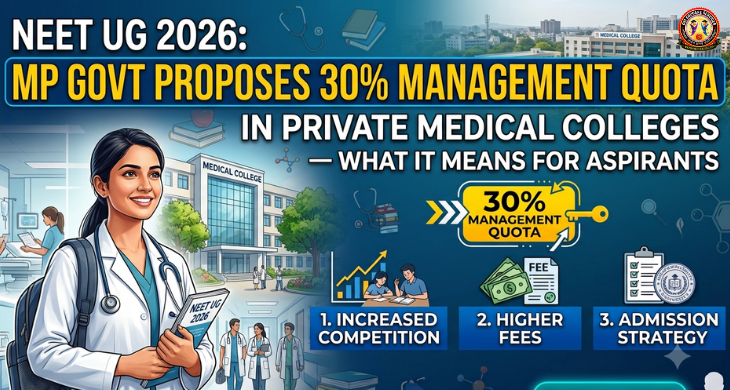
Big development for NEET UG 2026 aspirants eyeing Madhya Pradesh: the state government is reportedly moving to convert 30% of seats in private medical colleges into Management Quota, on top of the existing 15% NRI quota. If implemented, this could reshape merit cutoffs not just in MP, but across neighbouring states as displaced candidates look elsewhere for affordable private seats.
Here's a complete breakdown of what's changing, why, and what it means for you.
Before getting to the MP quota story, aspirants should also be aware of broader developments in NEET administration — including discussions around shifting future NEET UG exams to Computer Based Testing (CBT) mode, following recent changes in the Education Ministry leadership. A CBT-based NEET, if adopted, would likely involve multiple shifts (as is standard for large-scale computer-based exams), which raises valid concerns:
We'll continue tracking this and update you as official notifications come in. For now, let's focus on the confirmed and high-impact MP quota story.
Madhya Pradesh's private medical colleges currently operate seats primarily under two heads: the general/state quota (supported heavily by the Mukhyamantri Medhavi Vidyarthi Yojana, MMVY) and a 15% NRI quota. The new proposal adds a 30% Management Quota carved out of private college seats.
Why Is the MP Government Doing This?
The rationale ties directly to state finances. MP's flagship scholarship scheme — the Medhavi Chhatra Yojana (MMVY) — currently pays private college tuition fees on behalf of eligible domicile students, and this reportedly costs the state exchequer around ₹1,500 crore annually. By converting a chunk of these seats to management quota (where private colleges charge full, unsubsidized fees directly to students), the government is expected to save approximately ₹1,000 crore per year.
In short: fewer seats will be scholarship-eligible, and more seats will be sold at market rates directly by colleges.
The Numbers: How Many Seats Are Affected?
| Category | Approx. Seats |
|---|---|
| Total private MBBS/BDS seats in MP | ~2,501 |
| Seats proposed to shift to Management Quota | ~750 |
| Remaining under general/state-supported quota | ~1,751 |
Losing roughly 750 seats from the scholarship-backed pool means less room at the top for MP domicile students competing for state-quota seats — effectively pushing merit cutoffs higher for those still trying to get affordable private admissions through the regular route.
What Happens to Students Who Miss the Cut?
MP domicile candidates who don't make it into the shrunk general/state quota pool will increasingly be forced to either:
Expected Fee Structure Under Management Quota
Private colleges are reportedly pushing for fees as high as 3 times the regular tuition rate for these new management quota seats.
| Fee Type | Approx. Annual Fee |
|---|---|
| Current regular/state-quota private fee | ~₹12 Lakh/year |
| Projected Management Quota fee | ~₹30–36 Lakh/year |
For a full 4.5-year MBBS programme, that could mean a total cost upwards of ₹1.3–1.6 crore for a management quota seat — a massive jump for families who were previously budgeting around the ₹12 lakh/year mark.
Context from current market rates: Even without this change, management quota fees across Indian states already vary widely — from roughly ₹12–20 lakh/year in more regulated states to ₹27–45 lakh/year in states like Karnataka. MP's proposed rates would place it firmly in the higher bracket if implemented as described.
This is the part aspirants outside MP need to pay close attention to.
If ~750 MP-domicile candidates suddenly can't afford or don't secure the shrinking pool of subsidized private seats within their own state, a significant number of them will turn to low-budget private medical colleges in Uttar Pradesh, Bihar, and southern states as alternatives.
What this likely means:
This is a good example of how a single state's fee/quota policy can ripple across the entire national private medical education landscape — which is exactly why aspirants should track counselling policy news closely, not just their own state's exam and cutoff data.
Whenever quota structures or fee slabs change, fraudulent agents become more active — promising "confirmed" management quota seats, discounted fees, or backdoor admissions outside the official NEET counselling process. Please remember:
With quota structures shifting in states like Madhya Pradesh and cutoffs likely to move across multiple states as a result, expert, updated guidance matters more than ever this admission cycle. Om Educare provides transparent, fraud-free NEET UG counselling support — helping students and parents navigate state quota changes, fee structures, and college selection with verified, up-to-date information.
Helpline: 7676610620
Offices in Gurugram | Jamshedpur | Lucknow | Jaipur | Prayagraj

14-Aug-2026
14-Aug-2026
14-Aug-2026
14-Aug-2026
01-Aug-2026