19-Jun-2026
Author: Om Educare
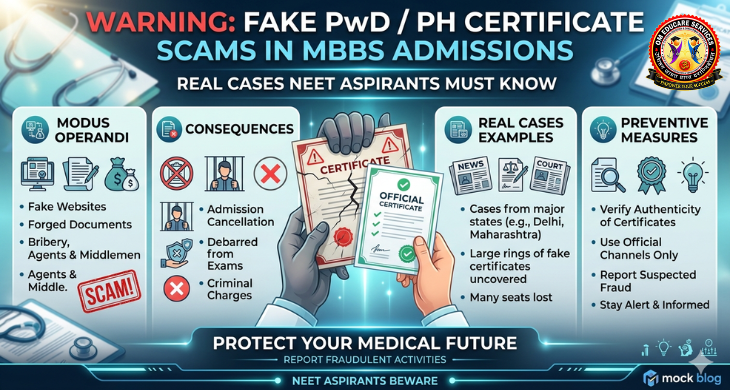
The Persons with Disabilities (PwD/PwBD) quota exists for one reason: to ensure that candidates with genuine benchmark disabilities get fair, supported access to medical education, with reserved seats and reasonable relaxations built into the admission process. It is one of the most carefully regulated categories in the entire NEET counselling system — and yet, precisely because PwD seats often come with a lower effective cutoff within the reserved pool, this quota has become a target for organised fraud.
Over the past year, cases have surfaced across India of able-bodied candidates obtaining fake disability certificates — sometimes with the help of doctors and government officials themselves — to gain an unfair edge in MBBS admissions. At Om Educare, we believe families need to understand exactly how serious, and how heavily investigated, this kind of fraud has become.
One of the most significant cases to emerge involved an organised network operating out of Karnataka. Malleswaram police arrested two more individuals — a government medical officer and a paediatrician — in connection with fake disability certificates issued to help candidates secure medical seats under the specially-abled quota, bringing the total number of arrests in the case to five, including a government doctor and a teacher.
The investigation began after the Karnataka Examinations Authority (KEA) filed a complaint when discrepancies were spotted during routine certificate verification. What KEA uncovered was striking in scale: twenty-one candidates applying for medical seats through UG CET and NEET UG that year had submitted forged certificates falsely claiming to be hearing impaired. Investigators now suspect the racket had been operating for years, with a network that included a teacher, a first-grade assistant, an assistant at a primary healthcare centre, and — most troublingly — qualified medical professionals who lent their credentials to issue fraudulent certifications.
This case shows how disability-certificate fraud in MBBS admissions isn't always a single desperate family acting alone — it can be a structured, paid network involving people with the authority to make fake documents look completely legitimate.
In Jammu & Kashmir, the Economic Offences Wing formally charged two individuals for using a fake physical disability certificate to secure a medical college admission. The case involved false representation of disability status to gain entry into a medical course the accused was not genuinely eligible for. The EOW's involvement signals how seriously such cases are now treated — disability-certificate fraud in medical admissions is investigated not just as an academic violation, but as an economic and criminal offence.
Not every disability-related controversy in NEET admissions involves fraud — and one Supreme Court case is worth understanding precisely because it shows the other side of the problem. Kabir Paharia, a genuine NEET UG candidate with a benchmark locomotor disability (40% or more, as legally defined), secured an excellent rank of 174. When assessed by the Disability Certification Centre at VMMC-Safdarjung Hospital, his disability was quantified at 68% — and despite this, the certifying body concluded he was not eligible to pursue medical courses under NMC norms.
Paharia challenged this in the Delhi High Court, which initially upheld the rejection after a second assessment. The case eventually reached the Supreme Court, which held that PwD candidates cannot be denied medical admission based on a strict, narrow assessment of their disability alone. The Court specifically noted that Paharia's only real difficulty during testing was putting on gloves — he successfully performed every other clinical task, from chest compressions to suturing — and ruled that certifying authorities must account for clinical accommodations and assistive technology before disqualifying a genuinely eligible candidate.
This case matters for a different reason than the fraud cases above: it shows why the verification system has to be rigorous on both ends — strict enough to catch fraudulent claims, but fair enough not to wrongly punish genuine PwD candidates. It's also a reminder that genuine PwD candidates facing an unfair rejection have legal recourse — but pursuing that recourse only works when their underlying disability and documentation are real.
In direct response to the growing pattern of fraudulent disability claims, the Medical Counselling Committee introduced significant changes to how PwBD certificates are verified for NEET UG counselling. Under the revised guidelines, Persons with Benchmark Disabilities are now required to mandatorily obtain their disability certificate from one of just 16 MCC-designated centres across the country — eliminating the wide network of smaller, less-scrutinised certifying centres that fraud networks had previously been able to exploit.
The new rules, which followed interim regulations notified by the National Medical Commission, also introduced a self-declaration process: candidates must complete self-certified affidavits in a prescribed format and then appear before the designated medical board for verification. Under these guidelines, only candidates who hold a valid UDID (Unique Disability ID) card issued by the Department of Empowerment of Persons with Disabilities, and who separately qualify NEET UG eligibility criteria, are considered for AIQ seats under the PwD category. This dual-layer requirement — a valid national UDID plus fresh assessment at a designated centre — is specifically designed to close the gap that earlier allowed forged or "purchased" certificates to slip through.
Based on the cases above, the pattern is consistent. Fraud networks recruit or bribe individuals with access to medical or certifying authority — as seen in the Bengaluru case, where a government doctor and a paediatrician were directly implicated — to issue disability certificates for candidates with no genuine disability. These certificates are then submitted during NEET counselling to claim PwD quota benefits, which often come with both reserved seats and a comparatively lower effective cutoff, since PwD candidates compete within a smaller, separate pool. Because verification at the state counselling-board level isn't always cross-checked against centralised UDID records or designated assessment centres, certificates manufactured by complicit officials could — until recently — pass through largely unchallenged, which is exactly why MCC moved to consolidate verification at just 16 designated centres.
If your child has a genuine, documented disability, none of this should discourage you — the PwD/PwBD quota exists specifically to support candidates like them, and the Kabir Paharia case shows that the law actively protects genuinely eligible PwD candidates from unfair rejection. What it does mean is that preparation now matters more than ever. Make sure your child's disability assessment and UDID card are obtained well in advance through proper, recognised government channels — never through a shortcut or a "helpful contact." Confirm that your NEET UG PwBD certificate is obtained specifically from one of the MCC-designated centres for the current counselling cycle, since older or non-designated certificates may no longer be accepted for AIQ seats. Complete the self-declaration affidavit accurately and be prepared for assessment before the designated medical board, understanding that the process exists to protect genuine candidates, not obstruct them. And if your child's disability assessment seems inconsistent with their actual functional ability — as happened in the Paharia case — know that there is a legitimate legal process to challenge it, and it does not require manufacturing or inflating any document.
For families without a genuine disability in the picture, the message from these cases is unambiguous. A fake PwD/PwBD certificate is not a low-risk shortcut — it is a criminal offence that has already resulted in police investigation, EOW charges, and multi-person arrest networks involving even doctors and government officials. With UDID verification and designated-centre certification now mandatory, the window for a fraudulent certificate to go undetected has narrowed considerably, and getting caught doesn't just end an MBBS admission — it can end a medical career before it even begins, and bring criminal prosecution down on the entire family.
At Om Educare — Empowering Future Doctors — we help PwD/PwBD candidates and their families navigate NEET UG counselling with complete clarity: understanding exactly which MCC-designated centres to approach, how the UDID and self-declaration process works, and how to ensure every document meets the current year's verification standards — so that a genuinely deserving candidate never loses their seat to an avoidable paperwork issue.
If your family needs guidance on PwD quota eligibility, certification, or the NEET UG 2026 counselling process, reach out to our counselling team today.
14-Aug-2026
14-Aug-2026
14-Aug-2026
14-Aug-2026
01-Aug-2026